
The best AI prospecting tool in 2026 depends on which part of the loop you want automated. Finding, enriching and sending are still three different products.
Key takeaways
- As of September 24, 2026, self-serve entry points run from $39 a month on Smartlead Base to $495 on Clay Growth, and LinkedIn Sales Navigator Core lists $119.99 per license a month.
- ZoomInfo and Cognism publish no price. Vendr data puts the median contract at $33,500 a year for ZoomInfo and $36,000 a year for Cognism.
- AI SDR platforms start at $250 a month on AiSDR Solo, and 11x contracts are reported near $40,000 a year.
- Instantly's 2026 benchmark, built on its 2025 platform data, puts the average cold email reply rate at 3.43 percent, 5.5 percent for the top quartile and above 10 percent for the top 10 percent of senders.
- For a ten-user team billed monthly, the entry plan costs €49 on Freelvy, which has no per-seat pricing, against $650 on Apollo Basic and $1,199.90 on Sales Navigator Core.
- A solo stack costs €49 a month on a single Freelvy plan, or $96 assembled from Apollo, billed annually, and Instantly. A scaled one on Clay Growth and Smartlead Unlimited Smart costs $669 a month.
The category is noisy because two very different products share the label. One kind helps a person prospect faster. The other tries to replace the person. The measured results are not the same.
The tools at a glance
Prices were read on each vendor's official page on September 24, 2026, and each section links the page it uses. ZoomInfo and Cognism publish no amounts, so their row shows procurement data from Vendr.
What does a ten-user team pay each month?
Per-seat pricing changes the ranking as soon as a team grows. On the entry plan billed monthly, ten users cost €49 on Freelvy, $69 on lemlist Email and $185 on Clay Launch, because none of the three charges per seat. The same team pays $650 on Apollo Basic and $1,199.90 on Sales Navigator Core.
| Option | Price |
|---|---|
| Freelvy Starter | €49 |
| lemlist Email | $69 |
| Clay Launch | $185 |
| Apollo Basic | $650 |
| lemlist Multichannel | $1,090 |
| Sales Navigator Core | $1,199.90 |
The chart compares the licence bill, not the output, since credits and sending volumes differ from plan to plan. ZoomInfo and Cognism publish no price, Amplemarket prices extra users on request, and Instantly and Smartlead price by sending volume rather than by user, so they are left out. Every total is our own multiplication of list prices.
What counts as an AI prospecting tool in 2026?
Three layers now carry the label. Data and search tools find the accounts. Orchestration and enrichment tools turn a name into a contactable row. Sending tools deliver the message and manage the mailboxes. A handful of products span more than one layer, and the autonomous AI SDR tier claims to span all three without a person.
Buying by label rather than by layer is the most common mistake. A team that buys a sending tool to fix a targeting problem gets faster delivery of the wrong list. Work out which layer is failing first, then read only that column of the table above.
Do AI SDRs actually work?
Partly, and less well than the marketing suggests. The pattern across 2026 reviews is that AI is good at research, enrichment and first drafts, and weaker at the judgement calls that decide who to contact and what to say.
Salesmotion, a sales intelligence vendor, reports a Dashly A/B test in which human SDRs generated 2.6 times more revenue than AI SDRs, with AI cold reply rates between 3 and 8 percent against 5 to 12 percent for human-sent email. Neither company publishes the method. The practical reading is to automate the research and leave the targeting and messaging decisions with a person.
Targeting is where the spread shows. Instantly's 2026 benchmark, built on its 2025 platform data, puts the average reply rate at 3.43 percent, the top quartile at 5.5 percent and the top 10 percent of senders above 10 percent, and it credits micro-segmentation and problem-focused messaging for the best results.
Freelvy, the whole loop from one prompt
Freelvy is our product, an AI sales platform. It works the way ChatGPT or Claude does. You describe the customer you want in one prompt, and Freelvy searches 40+ live sources at query time rather than filtering a stored database. It then enriches every row with verified contact data, 18 providers in cascade for emails and 12 for phone numbers, and writes and sequences the outreach in the same thread. The waterfalls find and verify more than 92% of emails and find more than 90% of phone numbers.
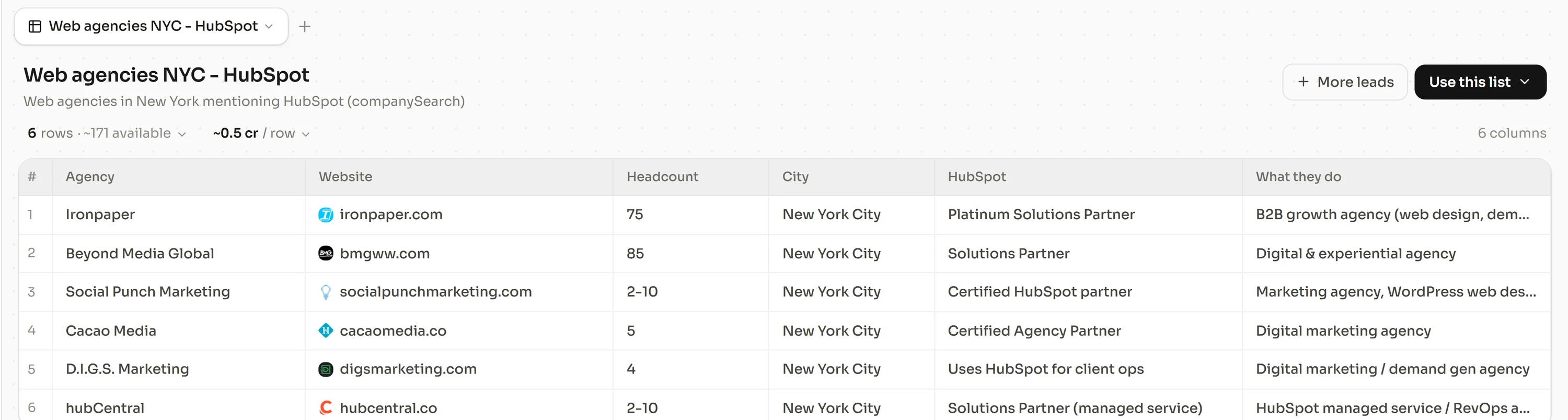
Best for founders and teams whose buyers sit across markets, sizes and niches that a stored database indexes poorly.
Strengths. Lead generation, enrichment and sequencing sit in one thread instead of three subscriptions. A row that fails verification is never delivered and never billed. The sequencer is unlimited on every plan and sends from your own Google or Microsoft mailbox, so sending is not billed per email. Credits pay for finding and verifying contacts and for writing sequences, with one charge per sequence, and as a rule of thumb one verified email is 3 credits. Team members are unlimited on every plan, with no per-seat pricing.
Price. €49 per month for 1,500 credits on Starter, €179 for 6,000 on Pro and €499 for 18,000 on Max. There is a free 7-day trial, no credit card, at freelvy.com.
Freelvy isn't for teams that would rather pay one tool for the data, another for enrichment and a third for sending.
1. Apollo, the widest bundle for the money
Best for small teams that want a database, sequences and a dialer without assembling a stack.
Strengths. At $49 to $119 per seat per month billed annually, nothing matches the feature count. A free tier exists for evaluation. Mid-market coverage in North America is solid, and the Chrome extension fits existing workflows.
Limits. Data accuracy outside North America is the recurring complaint, and Docket's Apollo pricing research, written by a sales software vendor, reports Apollo's phone accuracy at 65 to 70 percent against 75 to 85 percent for ZoomInfo. Phone numbers cost 8 credits and nothing rolls over.
Price. $49, $79 or $119 per seat per month billed annually, with a three-seat minimum on Organization, or $65, $99 and $149 billed monthly. Our Apollo pricing breakdown covers the credit rules.
2. ZoomInfo, the deepest enterprise database
Best for larger revenue teams with an annual software budget and a procurement process, whose motion depends on depth of company and contact data.
Strengths. ZoomInfo's official pricing guide lists more than 500 million professional contacts, 100 million companies and 120 million direct dials. A permanent free Lite tier gives 10 credits a month, or 25 with Community Edition, with no credit card and no annual commitment. That lets a team test the data before any sales conversation.
Limits. The same guide says paid plans are annual subscriptions, mostly billed upfront, and that monthly billing is not standard. Paid plans carry a minimum seat count, and data outside North America is sold as an add-on. Contracts renew automatically, so the notice date is worth putting in the calendar on signature day.
Price. Not published by the vendor, since the guide states no dollar amount for paid plans. Vendr's marketplace data, built on more than 1,000 purchases, puts the median contract at $33,500 a year, with deals from $7,213 to $155,820. Our ZoomInfo pricing analysis breaks down seats, credits and renewals.
3. Cognism, verified mobile numbers on an annual contract
Best for teams that call as much as they email and want mobile numbers checked before the dial.
Strengths. One credit reveals one contact, a contact already revealed can be viewed again at no charge, and the same credits work across the platform, Enrich and the API, per Cognism's pricing page. The Pro package adds on-demand mobile verification and intent data. The same page shows ratings of 4.5 out of 5 on G2 and 4.7 on Capterra.
Limits. Cognism publishes no price, so the evaluation runs through a sales conversation. Salesmotion, a sales software vendor, reports that there is no free plan and no monthly option, which places Cognism next to ZoomInfo rather than next to the self-serve tools.
Price. Not published by the vendor. The Standard and Pro packages each list 5 seats included. Salesmotion relays Vendr data putting the median contract at $36,000 a year across 108 purchases, with deals from $18,350 to $93,886. Our Cognism pricing analysis covers the quote structure.
4. LinkedIn Sales Navigator, prospecting inside LinkedIn
Best for sellers who build their accounts and relationships on LinkedIn and want AI help with research there.
Strengths. Every plan comes with more than 50 advanced search filters and 50 InMails a month, per LinkedIn's plan comparison. LinkedIn also lists AI account and lead insights, alerts on job changes, a Relationship Map and an AI message assistant in public beta. Eligible members can try Core or Advanced for free.
Limits. Every seller needs a license, so the bill grows with the team, as the chart above shows. The feature list centres on search, InMail and CRM sync, so an email sequence runs in a separate tool. Advanced Plus, the plan LinkedIn positions for teams with an integrated CRM, is priced on request.
Price. Core costs $119.99 per license a month or $1,079.88 a year, and Advanced costs $159.99 a month or $1,799.88 a year, per LinkedIn's page. Advanced Plus is quoted.
5. Clay, the orchestration layer
Best for technical growth teams that want to build enrichment waterfalls across many providers.
Strengths. Nothing else gives you this much control over which provider is tried in which order. Since the March 2026 rebuild, the most-used enrichments cost 50 percent fewer credits on average, according to Clay, and every plan includes unlimited seats. The Growth plan adds CRM auto-sync, HTTP API integrations and webhooks.
Limits. Two meters, Actions and Data Credits, make forecasting harder than one. Data Credits buy data from 150+ providers inside Clay, and teams that bring their own provider API keys pay those providers separately. If nobody on your team will maintain the tables, see our Clay alternatives for a small team.
Price. $185 a month on Launch and $495 on Growth, or $167 and $446 a month billed annually, per Clay's pricing page, with a free tier capped at 200 rows per table. Our Clay pricing analysis computes the cost per credit.
6. Amplemarket, signals, research and sequencing in one platform
Best for mid-market sales teams that want signals, research and sequence drafting in one product.
Strengths. Its Duo copilot scored 219 out of 231 in Amplemarket's own 2026 evaluation of eight platforms, a grid published by the vendor itself, and the same page reports 4.6 out of 5 from more than 571 G2 reviews. The design splits work across specialised agents for signals, research and sequencing.
Limits. The entry Startup plan runs on an annual term, and the Growth and Elite plans are quoted, so the commitment sits closer to Cognism and ZoomInfo than to the monthly self-serve tools. All plans include a free trial.
Price. $600 a month on Startup, annual term, with two users included, per Amplemarket's pricing page. Growth includes four users and Elite ten, and both are quoted.
7. Instantly, Smartlead and lemlist, the sending layer
These three tools deliver the message rather than find the buyer, so they are grouped here. Each does its job well, and teams usually pair one of them with a contact source.
Best for teams whose bottleneck is delivery rather than targeting. Instantly suits volume cold email, Smartlead suits agencies running many mailboxes for many clients, and lemlist suits teams that want LinkedIn steps and email in one sequence.
Strengths. Instantly and Smartlead include unlimited email accounts with warmup, which is the mechanism that makes cold email scale safely, and Smartlead takes 17 percent off on annual billing. lemlist's Email plan carries unlimited users with 50,000 messages a month, which is unusual pricing in a per-seat category, and its Multichannel plan adds LinkedIn, SMS and call steps.
Limits. Instantly runs three meters separately, covering outreach, credits and CRM, and its Starter bundle, which pairs sending with 1,500 credits a month, costs $94. Smartlead's verified prospect emails are a $59 monthly add-on on Base and Pro, for 2,000 and 30,000 a month, and are included on Unlimited Smart (50,000) and Unlimited Prime (170,000). lemlist's Multichannel plan is billed per user, so a team that only sends email pays for capability it will not use.
Price. Instantly Growth costs $47 a month, with credits sold separately from $47 a month, per Instantly's pricing page. Smartlead costs $39 on Base, $94 on Pro, $174 on Unlimited Smart and $379 on Unlimited Prime, per Smartlead's pricing page. lemlist costs $69 a month for the Email plan, or $55 billed annually, and $109 per user a month for Multichannel, or $87 billed annually, per lemlist's pricing page. Our Instantly pricing analysis works through the three meters. Our guide to Smartlead pricing plans explains how active leads and add-ons change the monthly bill.
What about the autonomous AI SDR tier?
This tier is expensive, and published results do not yet justify it for most teams. AiSDR lists Solo at $250, Explore at $900 and Scale at $2,500 a month on its pricing page. Artisan scopes its price per plan and publishes no figure, while Autobound's 2026 review reports $2,400 to $7,200 a month. 11x publishes no price either, and Prospeo cites Vendr data putting the median contract at $40,125 a year, with deals reported at $50,000 to $60,000.
Apart from AiSDR's Solo plan, autonomous platforms cost several times the self-serve tools above, and the Dashly test reported by Salesmotion found human SDRs generating 2.6 times more revenue than AI SDRs. Buy this tier when you have measured your own funnel and know exactly which step you are replacing.
What does a stack actually cost at three sizes?
Here is what a working setup costs each month at three realistic volumes, built from the prices above.
Every total is our own addition of list prices, not a package anyone sells. Teams that bring their own provider API keys to Clay pay those providers on top of the scaled row.
Which tool should you pick?
Pick by the layer that is failing and by how your team buys software. Each tool below wins in a different situation.
- Choose Freelvy if you want finding, enrichment and sequencing from one prompt, with unlimited team members.
- Choose Apollo if you want a database, sequences and a dialer in one self-serve bundle.
- Choose ZoomInfo or Cognism if your team buys data on an annual contract and needs depth on contacts and mobile numbers.
- Choose LinkedIn Sales Navigator if your sellers research and message prospects inside LinkedIn.
- Choose Clay if you have the technical skills to orchestrate many data providers.
- Choose Amplemarket if you want signals, research and sequence drafting on one annual platform.
- Choose Instantly, Smartlead or lemlist if your targeting works and delivery is the bottleneck.
Who should not buy any of this?
Teams whose low reply rate comes from the message should not buy any of this. Instantly's 2026 benchmark puts the average cold email reply rate at 3.43 percent, and on a single 16.5-million-email dataset Belkins measured a fall from 6.8 percent in 2023 to 5.8 percent in 2024, as compiled by Prospeo. No tool in this list fixes a value proposition. If your current campaigns get replies and you cannot keep up with volume, tooling helps. If they get silence, more volume produces more silence faster.
The second group is teams with fewer than fifty accounts worth contacting. At that size a spreadsheet and a well-researched email beat any platform, and the money is better spent on the research. If nobody books meetings for you, our guide on how to self-source pipeline without an SDR fits this work into four hours a week.
How we verified these numbers
Prices were read on the official pricing pages of Apollo, Clay, Instantly, Smartlead, lemlist, Amplemarket, AiSDR, Cognism and LinkedIn Sales Navigator, and in ZoomInfo's official pricing guide, on September 24, 2026. Each is linked at the point it is used. ZoomInfo, Cognism, Artisan and 11x publish no price, so their figures are third-party reports attributed in the text. The ZoomInfo contract data comes from Vendr's marketplace page and the Cognism data from Vendr figures relayed by Salesmotion, both read on September 24, 2026. The Amplemarket evaluation score is the vendor's own, and the Dashly test is reported by Salesmotion, also a vendor, without a published method. The four stack totals and the ten-user bills are our own arithmetic on list prices.
FAQ
What is the best AI prospecting tool in 2026?
There is no single answer, because the category spans three layers. For finding and reaching buyers from one brief, Freelvy. For a bundled database with sequences, Apollo. For an enterprise database on an annual contract, ZoomInfo or Cognism. For prospecting inside LinkedIn, Sales Navigator. For enrichment orchestration, Clay. For sending infrastructure, Instantly or Smartlead.
How much does an AI prospecting stack cost?
A solo setup costs €49 a month on a single Freelvy plan, or $96 assembled from Apollo Basic at $49 billed annually and Instantly Growth at $47, which becomes $112 with Apollo billed monthly. A three-person team on Apollo Professional and Smartlead Pro lands near $331, or $391 with Apollo billed monthly. A scaled setup on Clay Growth plus Smartlead Unlimited Smart costs $669 a month.
Do ZoomInfo and Cognism publish their prices?
No. ZoomInfo's pricing guide gives no dollar amount beyond its free Lite tier, and Cognism's pricing page lists its Standard and Pro packages without amounts. Vendr's data puts the median ZoomInfo contract at $33,500 a year, and Vendr figures relayed by Salesmotion put Cognism's at $36,000. Both sell paid plans on annual terms through a sales conversation.
Is LinkedIn Sales Navigator an AI prospecting tool?
It is a LinkedIn search and messaging tool with AI features added. LinkedIn lists AI account and lead insights and an AI message assistant in public beta, next to more than 50 search filters and 50 InMails a month. Core costs $119.99 per license a month, and email sequences still run in a separate tool.
Do AI SDRs replace human SDRs?
Not on the evidence available in 2026. Salesmotion, a sales intelligence vendor, reports a Dashly test in which human SDRs generated 2.6 times more revenue, with AI reply rates of 3 to 8 percent against 5 to 12 percent for human-sent email, and neither company publishes the method. The reliable gains are in research, enrichment and drafting rather than in autonomous sending.
Which tool has the best free plan?
Apollo offers a permanent free tier of roughly 75 credits a month, Clay gives 100 Data Credits capped at 200 rows per table, ZoomInfo Lite gives 10 credits a month, and Lusha gives 40 credits a month. LinkedIn offers eligible members a free trial of Sales Navigator, and Freelvy runs a free 7-day trial with no credit card. None of the sending tools in this list offers a free tier.
What reply rate should an AI-assisted campaign get?
Instantly's 2026 benchmark puts the platform average at 3.43 percent, the top quartile at 5.5 percent and the top 10 percent of senders above 10 percent. A campaign that reaches 5.5 percent is already ahead of three senders in four on that platform.
Do I need both a data tool and a sending tool?
Usually yes, unless you buy something that spans both layers. Freelvy runs search, enrichment and sequencing in one thread, and Apollo bundles a database with sequences. Instantly, Smartlead and lemlist now sell contact data next to sending, as credits, add-ons or bundles, which is why the assembled stack costs above add two line items rather than one.
Is Clay an AI prospecting tool or an enrichment tool?
Enrichment and orchestration first, with AI steps available inside the workflows. Its Data Credits buy data from 150+ providers inside Clay, and Launch adds a native email sequencer, while teams sending at volume can connect a dedicated sender through an integration.
Sources and methodology
Vendor pricing pages, ZoomInfo's pricing guide and the Vendr data were read on September 24, 2026, and the other pages were consulted between September 13 and September 24, 2026. Figures from third-party analyses are attributed in the text. Stack totals and ten-user bills are our own arithmetic. Three cited sources, Amplemarket, Salesmotion and Docket, are vendors writing about their own category, and are flagged where used.
- apollo.io, pricing
- apollo.io, pricing about credits
- pipeline.zoominfo.com, sales how much does zoominfo cost
- vendr.com, marketplace zoominfo
- cognism.com, pricing
- salesmotion.io, blog cognism pricing
- business.linkedin.com, sales solutions compare plans
- clay.com, pricing
- instantly.ai, pricing
- smartlead.ai, pricing
- lemlist.com, pricing
- amplemarket.com, pricing
- aisdr.com, pricing
- artisan.co, pricing
- instantly.ai, cold email benchmark report 2026
- autobound.ai, blog ai sdr tools guide
- amplemarket.com, blog best ai sales agents
- salesmotion.io, blog best ai sales agents outbound prospecting 2026
- prospeo.io, s ai sdr agents
- prospeo.io, s b2b cold email reply rates
- docket.io, research apollo pricing
- https://freelvy.com/pricing
Related: Clay pricing in 2026, ZoomInfo pricing in 2026, Apollo alternatives compared by problem, ZoomInfo alternatives scored on real cost, how to build a company list from a description and the cold email deliverability checklist.