
Most people do not search for an Apollo alternative because Apollo is bad. They search because one specific thing broke for them. In 2025 and 2026, three things broke most often, and all three are documented.
Key takeaways
- Apollo's paid plans run $49 to $119 per user per month on annual billing, and Basic costs $65 billed monthly, per the official page read on September 24, 2026.
- The three documented reasons people leave: a free plan capped near 10 exports a month, weaker accuracy outside the US, and credits that expire.
- For a team of 10 users billed monthly, Freelvy Starter costs €49 with unlimited team members, against $370 on RocketReach Essentials, $469.10 on Lusha Pro and $650 on Apollo Basic.
- Lusha and RocketReach publish self-serve prices from $37.45 and $19 a month on annual billing, while Seamless.AI publishes no paid price at all.
- Best EMEA phone data: Cognism, on annual contracts reported at about $20,000 a year to start.
- ZoomInfo is a different budget: median contract $33,500 per year (Vendr, 1,000+ deals).
First, the free plan quietly stopped being usable. Apollo is moving every account to a unified credit system (new accounts start on it and existing ones migrate progressively, according to its pricing FAQ), and pricing analyses of the change report that free accounts now get about 75 general credits a month and roughly 10 export credits. Ten exports a month is an evaluation tier, and plenty of solo users only discovered it when their workflow stopped.
Second, data accuracy outside North America. A 2026 review of Apollo's G2 profile notes that multiple reviewers report outdated job titles and invalid phone numbers in European, APAC and LATAM data, and MailReach's 2026 review puts Apollo's accuracy around 88 percent in the US and 60 to 73 percent internationally.
Third, credit math. Credits are spent on export, a phone number costs 8 credits against 1 for an email according to Apollo's credits page, nothing rolls over, and teams regularly run out before renewal. The sticker price and the real monthly cost are different numbers, as our Apollo pricing breakdown shows plan by plan.
If none of that hurts you, keep Apollo. If one of them does, the right alternative depends on which one.
What Apollo still does well
Apollo remains the best feature-for-price bundle in the category. For $49 to $119 per user per month billed annually you get a database that Apollo's site puts at 240M contacts and 30M companies, sequences, a dialer, CRM sync, and a Chrome extension in one product. SalesQuants' 2026 review calls it the best all-in-one outbound tool, if you can live with imperfect data. On US mid-market accounts, the data is genuinely decent. Every alternative below beats Apollo on something and loses to it on something else.
The eight alternatives at a glance
Eight tools cover the main reasons people leave Apollo, from a prompt-driven platform to browser extensions, per-seat databases, a workflow builder and enterprise contracts. The table gives each entry price as read on September 24, 2026, and the chart below turns those prices into the monthly bill of a 10-user team.
Apollo, Lusha, RocketReach, Clay and Lead411 prices were read on their official pricing pages on September 24, 2026. Seamless.AI, Cognism and ZoomInfo publish no paid prices, so their figures are third-party estimates, linked in the text.
The chart compares one situation, a team of 10 users on the cheapest plan that allows it, billed monthly. Seamless.AI, Cognism and ZoomInfo are left out because they publish no price to compute from.
| Option | Price |
|---|---|
| Freelvy Starter | €49 |
| Clay Launch | $185 |
| RocketReach Essentials, 10 users | $370 |
| Lusha Pro, 10 users | $469.10 |
| Apollo Basic, 10 users | $650 |
The bill is not the whole story, because the included volume differs. Ten Apollo Basic seats come with 2,500 credits per seat a month, Lusha Pro shares 600 credits a month across the team, and Clay Launch includes 2,500 data credits. RocketReach Essentials gives 100 email exports per seat a month, and Freelvy Starter includes 1,500 credits.
Freelvy: if you would rather describe your customer than operate a database
Freelvy is our product, an AI sales platform. You use it the way you use ChatGPT or Claude. You describe the customer you want in one prompt, and Freelvy searches 40+ live sources at query time instead of filtering a stored database. Every row is enriched with verified contacts, through 18 email providers in cascade and 12 phone providers, and a row that fails verification is never delivered and never billed. The waterfalls find and verify more than 92% of emails and find more than 90% of phone numbers. It then writes and sequences the outreach in the same thread. The sequencer is unlimited on every plan and sends from your own Google or Microsoft mailbox, so sending is not billed per email.
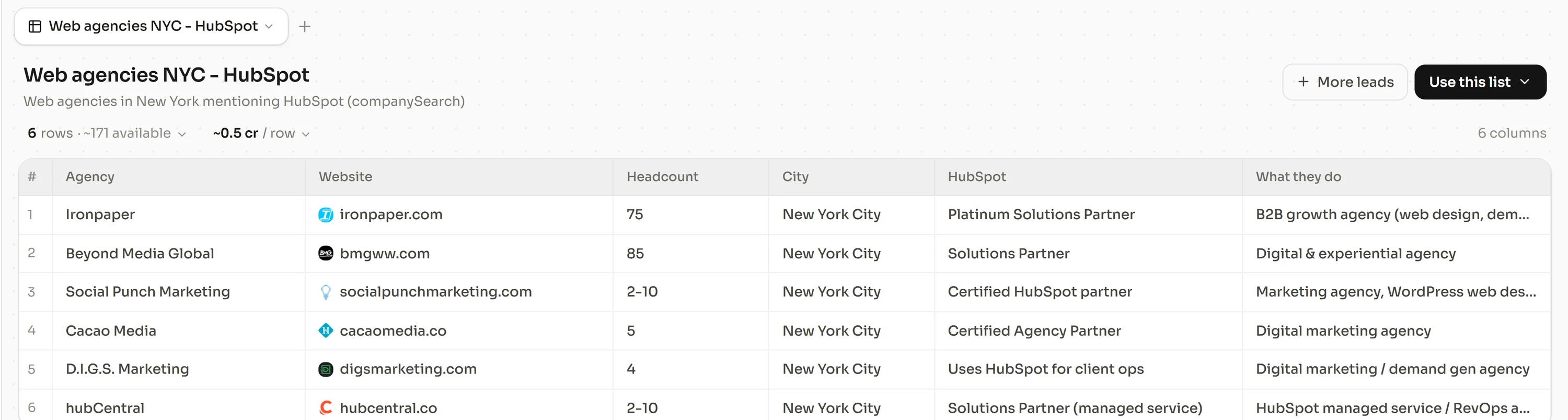
Where Apollo asks you to assemble filters, export, then move the list into sequences, Freelvy keeps lead generation, enrichment and sequencing in one thread. Credits pay for finding and verifying contacts and for writing sequences, with one charge per sequence, and as a rule of thumb one verified email is 3 credits. Team members are unlimited on every plan, with no per-seat pricing, so every one of your account executives can prospect from the same plan. Starter is €49 a month for 1,500 credits, Pro is €179 for 6,000 and Max is €499 for 18,000. Free 7-day trial, no credit card, at freelvy.com.
Freelvy isn't for teams that would rather pay one tool for the data, another for enrichment and a third for sending.
1. Lusha: if you want contacts inside the tools you already use
Lusha suits the rep who needs a contact while already looking at a profile, a CRM record or a company website. Its browser extension brings emails and phone numbers into that screen, and its self-serve plans start low. Phone reveals cost five times an email, so the bill rises with calling.
Best for individual reps and small teams who want quick lookups without changing their workflow.
Strengths. The extension works on professional networks, in CRMs and on any website, per Lusha's pricing page. The free plan gives 40 credits a month with no credit card. On monthly Pro and Premium plans, unused credits roll over up to twice the monthly allowance, which answers part of the frustration with Apollo's expiring credits.
Limits. A phone number costs 5 credits against 1 for an email, per Lusha's own FAQ, so calling-heavy use drains a plan fast. Starter includes a single seat. With 10 seats selected on Pro, the page shows $469.10 a month on monthly billing, still with 600 credits a month for the whole team. On annual plans the year of credits is granted upfront.
Price. Free, then Starter $37.45, Pro $52.45 and Premium $299.95 a month billed annually, or $49.90, $69.90 and $399.90 billed monthly, per Lusha's pricing page. Starter includes 400 credits a month and one seat, Pro 600 credits and two seats, and Premium 3,400 credits and five seats. A custom Scale plan goes through sales.
2. Seamless.AI: if you want unlimited exports and are ready to negotiate
Seamless.AI fits a team that exports at volume and accepts a sales-led, annual purchase. Its paid plans list unlimited exports and a real-time search engine, and for a limited time every plan includes built-in emailing and calling. The trade-off is price visibility, because no paid price appears on its page.
Best for sales teams that export contacts at high volume and prefer a negotiated annual contract.
Strengths. The pricing page lists a real-time search engine, emails, mobile numbers and direct dials, and unlimited exports on Pro. For a limited time, every plan includes Connect, its built-in tool for emailing, calls and tasks. A free plan gives one user 50 credits to test the data before talking to sales.
Limits. No paid price is published, so a budget needs a sales call. Pro is sold per user on annual credit packages that start at 10,000 credits a year, per the page's FAQ, and custom plans work with a daily credit allotment for five licences or more.
Price. Not published by the vendor. Cleanlist's 2026 pricing guide relays a Basic plan at $147 a month billed yearly, visible only after sign-up, and reviewer reports of $150 to $500 per user per month for Pro and Enterprise. The official pricing page, read on September 24, 2026, lists Free, then Pro and Enterprise on quote.
3. RocketReach: if you want the lowest self-serve seat price
RocketReach has the lowest self-serve entry price in this list, $19 per seat a month on annual billing. It suits individuals and small teams who want a clear export quota and a lookup that is refunded when nothing verified comes back. Phone numbers start on the second plan, not the first. Our breakdown of RocketReach pricing per lookup shows what each plan really costs per result.
Best for individuals and small teams who want a low seat price and a predictable export quota.
Strengths. RocketReach's page claims 700 million professionals and 60 million companies. A lookup that returns no verified email or phone is refunded, per its FAQ. Paid plans include sequences with a sending limit of 500 emails a day, and a free account gets 5 lookups without a credit card.
Limits. Essentials, the entry plan, covers emails only, and phone numbers start on Pro. Exports are capped by plan, from 1,200 to 20,000 a year on annual billing, or 100 to 1,000 a month on monthly billing. Custom team plans start at $6,000 a year.
Price. Essentials $19, Pro $52 and Ultimate $115 per seat per month billed annually ($229, $619 and $1,379 a year), or $39, $79 and $169 billed monthly, per RocketReach's pricing page. With 10 seats selected on monthly billing, the page shows $37, $75 and $161 per seat after its multi-seat discount.
4. Cognism: if your problem is European phone data and you have budget
Cognism attacks Apollo's weakest flank, EMEA accuracy, with phone-verified mobile numbers it brands Diamond Data. It is built for calling teams that sell into Europe and can sign an annual contract. There is no public price and no self-serve tier.
Best for EMEA calling teams with an enterprise budget.
Strengths. Cognism's own page says Diamond Data numbers are three times more likely to connect than standard numbers. MarketBetter's 2026 review notes a claimed 98 percent accuracy on those records and places Diamond Data's strongest coverage in the UK and Western Europe.
Limits. The buying model is the trade-off. There is no public pricing and no self-serve tier, so a small team has no small first step. If you are a small team, this is not your tool. If you run an EMEA calling team with real budget, it probably is.
Price. Not published by the vendor. 2026 pricing guides report about $20,000 a year to start on annual contracts, and Vendr's median Cognism contract is $36,000 a year across 108 purchases, as relayed by Salesmotion.
5. Clay: if you outgrew databases and want to build workflows
Clay is not a database and does not pretend to be one. It is a spreadsheet-shaped orchestration layer that runs enrichment waterfalls across dozens of third-party providers and lets you build scoring and personalization workflows on top. Technical growth teams love it for a reason.
Best for technical growth teams that want to build their own enrichment waterfalls and scoring.
Strengths. Clay chains many providers in one table, so a missing email from one source can come from the next. Seats and tables are unlimited on every plan, including the free one, per its pricing page, which keeps the bill flat as the team grows.
Limits. Clay rebuilt its pricing in March 2026 and runs a dual credit system, data credits plus actions, that consumes on two counters at once. If Apollo's credit math frustrated you, Clay's is more powerful and also harder to predict. Budget learning time, because the tool rewards spreadsheet engineering.
Price. Its pricing page lists a free plan, then Launch from $185 a month and Growth from $495 ($167 and $446 on annual billing). Launch includes 2,500 data credits and 15,000 actions a month.
6. Lead411: if your problem is credit anxiety itself
Lead411 sells the simplest counter in this list, a fixed number of exports a month with rollover. There is no credit currency and no mobile-costs-8x surprise, and the rollover answers the exact frustration Apollo's expiring credits create. For small US-focused teams that want a predictable bill, that simplicity is the feature.
Best for small US-focused teams that want a predictable bill.
Strengths. Unused exports roll over to the next cycle, and emails are re-verified every three to six months, per its pricing page. Direct phone numbers are included in the export counter rather than priced at a premium.
Limits. Its limits are the mirror image of its simplicity, with thinner international coverage, notably in Europe, and a lighter platform than Apollo around the data. Several users with admin control require the Ignite or Blaze plans, per the page's FAQ.
Price. Spark costs $49 per month for 1,000 exports, or $490 per year for 12,000. Ignite starts at $150 a month, and Blaze is on quote.
7. ZoomInfo: if you are shopping in a different price universe
ZoomInfo remains the enterprise reference for US data, intent signals, and org charts. It is also a different budget conversation entirely, sold on annual contracts with no public price. That budget buys materially better US enterprise coverage and procurement-grade features.
Best for US enterprise sales teams that need intent signals and org charts.
Strengths. It covers US enterprise accounts, intent data and org charts at a depth that Apollo does not match, with features built for procurement and large teams. Our Apollo vs ZoomInfo comparison runs the numbers seat by seat.
Limits. At entry level, ZoomInfo costs about 25 times the $588 a year of one Apollo Basic seat on annual billing. For anyone reading an "Apollo alternatives" article to escape credit fees, this is the wrong direction.
Price. Not published by the vendor. 2026 guides report entry around $15,000 per year with a 3-seat minimum, and Vendr's marketplace data puts the median contract at $33,500 per year across more than 1,000 analyzed purchases. Compared median to median on Vendr, ZoomInfo costs about 1.8 times Apollo, whose median contract is $19,000 a year across 101 purchases.
What if your real problem is sending, not finding?
Then the fix is a sending tool, not a new database. A share of Apollo churn comes from teams that hit sending limits or deliverability walls. Instantly starts at $47 per month for sending, with unlimited email accounts and warmup, and sells its lead database separately from $47 a month for 1,500 credits. Pair it with one of the data sources above. Before any new list reaches a rep, dedupe the prospect list against your CRM so nobody emails an account with an open deal.
Who should simply stay on Apollo
Staying is often the right call. Keep Apollo if your accounts are mostly US mid-market, you use the bundle broadly, sequences plus dialer plus database, and your credit consumption sits comfortably inside your plan. No alternative on this list replicates that bundle at that price point. Switch only when one of the three documented problems, the free-tier ceiling, non-US accuracy, or credit unpredictability, costs you real pipeline.
How to choose in three questions
- Where are your buyers? Buyers spread across markets, sizes and niches that a stored database indexes poorly point to Freelvy's live search. Mostly US enterprise points to ZoomInfo. EMEA calling with budget points to Cognism.
- What do you want to operate? One prompt that returns the list, the enrichment and the sequence points to Freelvy. Quick lookups from a browser extension point to Lusha. A low seat price with a clear export quota points to RocketReach, and a simple counter with rollover points to Lead411. Sending infrastructure alone points to Instantly.
- How much building and buying do you want to do? No building points to an agent or a database. A lot of building, with a team that enjoys it, points to Clay. A negotiated annual contract with unlimited exports points to Seamless.AI.
If the answer to question two is what brought you here, Freelvy comes with a free 7-day trial, no credit card, at freelvy.com.
How we verified these numbers
We read the official pricing pages of Apollo, Lusha, Seamless.AI, RocketReach, Clay, Lead411 and Instantly on September 24, 2026, and Apollo's credits page on September 23, 2026. Seamless.AI, Cognism and ZoomInfo publish no paid prices; their figures come from the third-party analyses and procurement data linked in the text.
FAQ
Does Apollo still have a free plan in 2026?
Yes. The official page lists a free plan with 900 credits a year, granted monthly, which is about 75 credits a month. HeroHunt's analysis of the credit migration reports about 10 export credits a month, which makes it an evaluation tier rather than a working plan.
What is the cheapest Apollo alternative?
On sticker price, RocketReach Essentials costs $19 per seat a month billed annually, or $39 billed monthly, for emails only. Lead411 Spark costs $49 a month for 1,000 exports, and Freelvy starts at €49 a month for 1,500 credits, with unlimited team members, search, enrichment and sequencing included. Instantly starts at $47 but covers sending, not data.
What does an Apollo alternative cost for a team of 10?
On monthly billing and the cheapest plan open to 10 users, Apollo Basic costs $650 a month, Lusha Pro $469.10, RocketReach Essentials $370 and Clay Launch $185, per their pricing pages on September 24, 2026. Freelvy Starter costs €49 with unlimited team members. Included credits differ, so compare volume as well as the bill.
Is Lusha cheaper than Apollo?
For one user on monthly billing, yes. Lusha Starter costs $49.90 a month against $65 for Apollo Basic. Billed monthly, Apollo Basic includes 2,500 credits a month against 400 for Lusha Starter, though, and a phone number costs 5 credits on Lusha and 8 on Apollo. Per credit, Apollo gives more volume.
How much does Seamless.AI cost?
Seamless.AI publishes no paid price. Its page lists a free plan with 50 credits for one user, then Pro and Enterprise on quote, with Pro starting at 10,000 credits a year. Cleanlist's 2026 guide relays a Basic plan at $147 a month billed yearly and reviewer reports of $150 to $500 per user per month.
Which Apollo alternative has the best European data?
For teams that would rather describe a customer than run a database, Freelvy searches 40+ live sources at query time, and a row that fails verification is never delivered and never billed. Cognism is the established reference for EMEA phone data, with phone-verified mobiles, on annual contracts reported at about $20,000 a year to start.
Is Clay a replacement for Apollo?
Not directly. Clay is an orchestration layer that runs enrichment waterfalls across third-party providers, not a database. It suits technical teams building custom workflows, has a free plan and starts at $185 a month for Launch on its pricing page, and runs two credit counters at once, which makes costs harder to predict than Apollo's.
Should I move from Apollo to ZoomInfo?
Only if your buyers are US enterprise accounts and you have the budget. Third-party guides put entry around $15,000 a year with a 3-seat minimum, and Vendr's median contract is $33,500. For anyone leaving Apollo over credit fees, ZoomInfo moves in the opposite direction.
Sources and methodology
The official pricing pages of Apollo, Lusha, Seamless.AI, RocketReach, Clay, Lead411 and Instantly, and Cleanlist's Seamless.AI guide, were read on September 24, 2026. The other pages below were consulted on September 23, 2026. Prices from official pages are stated directly; figures from third-party analyses are attributed in the text.
- herohunt.ai, blog apollo pricing 2026 free tier cut and alternatives
- syncgtm.com, blog apollo io review
- mailreach.co, blog apollo io review
- apollo.io, pricing
- apollo.io, pricing about credits
- salesquants.com, apollo io review 2026 the best all in one outbound tool if you can live with imperfect data
- lusha.com, pricing
- seamless.ai, pricing
- cleanlist.ai, blog 2026 03 19 seamless ai pricing guide
- rocketreach.co, pricing
- marketbetter.ai, blog cognism review 2026
- cognism.com, diamond data
- cleanlist.ai, blog 2026 03 19 cognism pricing guide
- salesmotion.io, blog cognism pricing
- clay.com, pricing
- cleanlist.ai, blog 2026 03 12 clay pricing changes 2026
- lead411.com, pricing
- instantly.ai, pricing
- cleanlist.ai, blog 2026 03 19 zoominfo pricing guide
- vendr.com, marketplace zoominfo
- vendr.com, marketplace apollo io