
Pick 50 accounts you already know, have each vendor enrich the same file, and score verified emails, bounces and phones before comparing any price.
Key takeaways
- A vendor trial only measures something when every vendor enriches the same sample of accounts whose real contacts your team already knows.
- BounceZero's 2026 analysis of 7.8 million addresses verified between November 2025 and June 2026 classed 22.7% as invalid and 17.4% as catch-all or risky.
- BounceZero's Inbox Infrastructure Report 2026, published in August 2026, found that 20.0% of the domains it probed accepted mail for any address, so a "valid" result there proves nothing.
- Google's sender guidelines ask bulk senders to keep reported spam below 0.3% and to aim under 0.1%, so a bad test send has a real cost.
- The number that decides the contract is cost per usable contact, the price divided by contacts that passed every check, never the list price per credit.
A RevOps owner usually meets a data vendor's quality for the first time after the contract is signed, in the bounce report. This guide moves that moment to the trial, with a test one person can run in an afternoon and a scorecard you can copy.
Why does a normal vendor trial tell you so little?
Because the vendor picks the accounts. A demo search runs on well-known companies with large public footprints, where every database looks good. Your territory is the long tail: small companies, recent hires, regional subsidiaries. A trial only means something when it runs on your accounts, under your rules, with results you can check.
Three habits make trials misleading. Reps try a few names they are curious about, so nobody counts misses. Each vendor gets a different list, so results cannot be compared. And "found" is taken at face value, although a found address can still bounce.
The fix is a controlled test. One sample, the same file for every vendor, the same definitions of a hit, and a short send to prove deliverability. It takes an afternoon of work, spread over the length of the trial.
Which criteria should the test measure?
Six criteria cover what a data contract really buys. Match rate on your accounts, verified email rate, real bounce rate on a small send, phone numbers that reach the right person, freshness on known job changes, and cost per usable contact. Score each one separately, because one blended accuracy number hides the weak field.
Record misses as carefully as hits. A vendor that returns 40 contacts out of 50 with 10 bounces is worse than one that returns 32 with none.
How do you build the test sample?
Use 50 accounts your team already knows well, chosen to look like your real territory. Mix recent closed-won deals, open opportunities and accounts that replied in the last quarter. For each one, write down the two or three people you actually deal with and how you reached them.
That record is your answer key. When a vendor returns a contact, you can check the name, the role and the address against something a rep confirmed in a conversation. Without an answer key you are only counting returned rows.
Shape the sample like your pipeline, not like a demo. If a third of your deals are companies under 50 employees, a third of the sample should be too. Include a handful of accounts where a known contact changed jobs in the last six months. Those rows are your freshness test.
Then strip the file down to what a vendor would receive in real use: company name, domain and the target job titles. Do not send the names you already know. The vendor must find them.
How do you run the test in an afternoon?
Send the same file to every vendor on the same day, ask each for the target contacts, and collect the results in one sheet. Then run four checks in order: compare against the answer key, verify, send a small test, and dial the numbers. Most of the time is spent waiting for files, not working.
- Build a 50-account answer key
- Send each vendor the same file
- Score matches and verified emails
- Send a small test from a spare domain
- Compute cost per usable contact
Keep the test send small and safe. Use a secondary domain that does not carry your company's normal email, send a short, relevant message, and stop at the first sign of trouble. Google's sender guidelines ask bulk senders to keep reported spam under 0.3%, and to aim below 0.1%. Microsoft has required authentication from senders of more than 5,000 messages a day since May 5, 2025.
Dial the numbers in one block. Belkins' 2026 cold calling benchmarks, built on more than 175,000 dials, put the connect rate at 9.9% per dial and 24.5% per prospect when repeat attempts are counted. Read your result against that base, not against 100%.
How do you read catch-all and unknown results?
Count them apart. A catch-all domain accepts every address, so a server check cannot confirm the mailbox. A vendor that reports those rows as valid is inflating its verified email rate. Score catch-all rows as unconfirmed and look at how each vendor labels them.
The share is large enough to swing a test. BounceZero's Inbox Infrastructure Report 2026 probed domains seen on commercial lists between February and August 2026 and found that 20.0% accepted mail for any address. BounceZero is an email validation vendor, and its sample leans toward B2B lists.
Invalid addresses are common too. In BounceZero's analysis of 7.8 million addresses, 22.7% were invalid, 17.4% catch-all or risky and 48.3% verified. A vendor whose rows bounce at anything near those rates on your test send has not verified them.
Our guide on how to verify a B2B email list explains each check, from syntax to the catch-all probe.
How do you test freshness?
Use the job changes you already know. For every sample contact who left or moved in the last six months, check what the vendor shows: the old title, the new company, or nothing. A vendor that still sends you to the old employer will do the same across your whole territory.
Contact data ages fast. The commonly cited estimate is roughly 22.5% a year, or about 2.1% a month, repeated by Landbase and Cleanlist in 2026. Treat it as an order of magnitude. Your freshness rows give you the real figure for your segment.
Ask one more question in writing. How often is a record re-verified, and what date does the vendor show for the last check? A vendor that cannot answer is selling a snapshot.
What does a usable contact actually cost?
Divide what you would pay by the contacts that passed every check: matched, verified, not bounced, and at the right company. That is cost per usable contact, and it is the only number you can compare across per-seat plans, credit packs and annual contracts. List price per credit hides the misses.
Here is the arithmetic on an invented example. A vendor charges $500 a month for 1,000 credits and returns contacts for 40 of 50 sample accounts. If 10 of those bounce or sit at the wrong company, 30 contacts are usable. Scaled up, each usable contact costs a third more than the credit price suggests.
Add the contract terms to the same sheet. Check whether credits expire, whether a failed lookup is billed, how many seats are required and how much notice cancels the renewal. Our analysis of what prospecting data costs for a sales team walks through per-seat and usage models.
A scorecard you can copy
This is the sheet we would hand a RevOps team before a trial. One row per vendor, filled from the same 50-account file. The thresholds are starting points that teams commonly use; set your own before the first file comes back, not after.
Vendor test scorecard (same 50-account file for every vendor)

Vendor: ____________   Trial dates: ________   Plan quoted: ________

1. Accounts matched:            __ / 50     target: 45 or more
2. Target contacts requested:   __
3. Contacts returned:           __
4. Emails marked valid:         __          catch-all shown apart? yes / no
5. Test send, emails sent:      __          hard bounces: __   (stop above 2)
6. Phones dialled:              __          right person or voicemail: __
7. Known job changes (__):      shown at new company __   still at old __
8. Usable contacts (passed 1-7): __
9. Monthly price or credits spent for this file: ______
10. Cost per usable contact (9 / 8): ______

Contract: credits expire after ____   failed lookups billed? yes / no
          seat minimum ____   renewal notice ____ days   monthly option? yes / no
Send the vendor this brief with the file: "Return up to three contacts per account in these titles, with work email, verification status per address, direct or mobile number where you have one, and the date each record was last verified. Mark catch-all addresses as such."
What if you sell alone and only have twenty accounts?
Run the same test on 20 accounts. A founder rarely has 50 closed deals, but twenty accounts where they know the buyer are enough to see a weak vendor. Skip the phone block if you do not call, and keep the test send to a handful of addresses.
The smaller sample makes each miss count more, so read the result as pass or fail rather than as a percentage. If a vendor misses five of twenty accounts you know are real, it will miss a quarter of your market. Our list of B2B contact data without an annual contract helps when the trial is the only commitment you want.
Where Freelvy fits
Freelvy is our product, an AI sales platform used the way you use ChatGPT or Claude. You can paste the brief above, or describe the customer in one prompt, and Freelvy searches 40+ live sources at query time, including maps, official company registries, job boards, storefronts and ad libraries, instead of filtering a stored database.
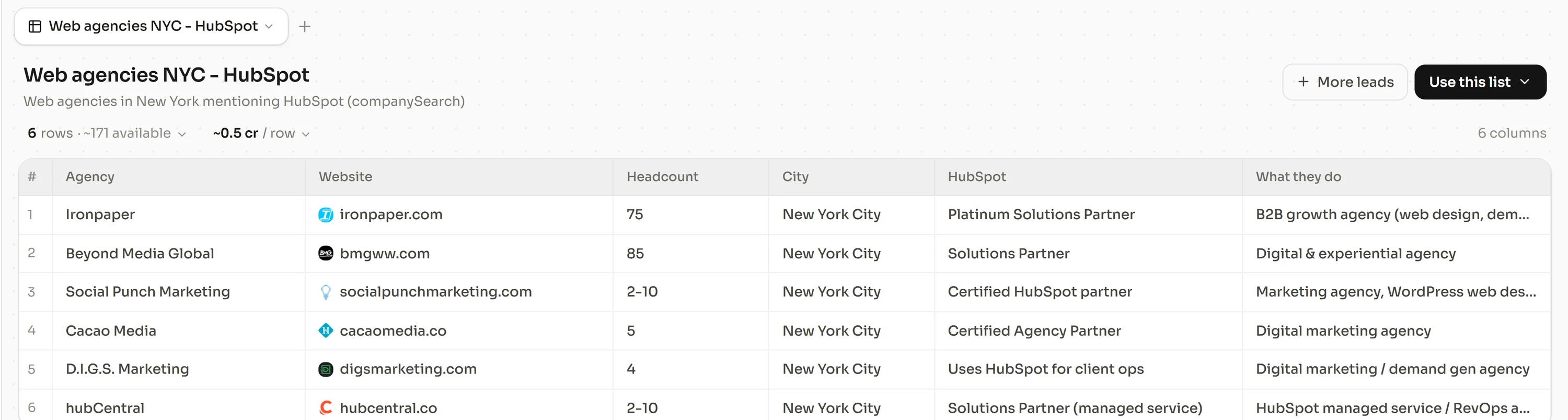
Every row goes through data enrichment with cascades of 18 email providers and 12 phone providers. They find and verify more than 92% of emails and find more than 90% of phone numbers, and an email lookup that finds nothing is never billed. Freelvy then writes and sequences the outreach in the same thread, so search, enrichment and sequencing stay together.
Pricing is per seat, billed monthly, with no lock-in. Starter costs €99 per seat a month with 2,200 credits per seat, and Pro €199 with 4,500. A verified email costs 3 credits and a phone number found costs 15. Seats are unlimited and managers get free view-only access, so the whole test team can read the results.
Free 7-day trial, no credit card, at freelvy.com.
Freelvy isn't for teams that would rather pay one tool for the data, another for enrichment and a third for sending.
How we verified this
On October 19, 2026, we read BounceZero's State of Email Validation in 2026 and Inbox Infrastructure Report 2026, Google's email sender guidelines and FAQ, Microsoft's Outlook post on requirements for high-volume senders, Belkins' 2026 cold calling benchmarks, the 2026 data decay analyses of Landbase and Cleanlist, and ZoomInfo's free trial page. The criteria, the scorecard and the worked example are our own.
FAQ
How many accounts should a data vendor test use?
Fifty accounts your team knows well is enough to compare vendors, and twenty works for a founder selling alone. What matters more than size is the answer key: for each account, the contacts a rep has actually confirmed. Without it, you count returned rows instead of correct ones.
What is a good match rate for a B2B data vendor?
Set the bar before the test, from your own territory. Many teams expect 45 of 50 known accounts to be recognised and judge contacts separately. Score each field apart, because a vendor can return most emails and few phones, and one blended figure hides that.
How do I test email accuracy without hurting my domain?
Send a short, relevant message to a small batch from a secondary domain that does not carry your normal company email. Stop at the first bounces. Google's sender guidelines ask bulk senders to keep reported spam under 0.3% and to aim below 0.1%.
Should catch-all addresses count as verified?
No. A catch-all domain accepts mail for any address, so a server check cannot confirm the mailbox. Count those rows as unconfirmed. BounceZero's August 2026 report found catch-all behaviour on 20.0% of the domains it probed, enough to inflate any vendor's verified email rate.
How long does a data vendor trial take?
The work fits in an afternoon: building the answer key, sending the file, scoring results and dialling the numbers. The elapsed time is set by the vendors returning files and by the test send. ZoomInfo's trial page says its free trial typically runs seven days for new users.
What should I ask a vendor before signing?
Ask how often records are re-verified and what date is shown for the last check, whether failed lookups are billed, when credits expire, how many seats are required, and how many days of notice cancel the renewal. Put the answers in the order form, not only in an email.
Sources and methodology
All pages below were read on October 19, 2026. BounceZero is an email validation vendor, Landbase and Cleanlist sell data tools, and Belkins is an outbound agency; their figures describe their own data. The scorecard and the worked example are our own work.
- bouncezero.io, The State of Email Validation in 2026
- bouncezero.io, The Inbox Infrastructure Report 2026
- support.google.com, Email sender guidelines and Email sender guidelines FAQ
- techcommunity.microsoft.com, Outlook's new requirements for high-volume senders
- belkins.io, B2B cold calling statistics 2026
- landbase.com, Data decay rate statistics
- cleanlist.ai, B2B data decay statistics
- zoominfo.com, Free trial