Ten seats cost $5,880 a year on Apollo's cheapest annual plan, the median ZoomInfo contract is $33,500, and utilization moves cost per contact tenfold.
Key takeaways
- As of September 23, 2026, ten Apollo seats cost $5,880, $9,480 or $14,280 a year on annual billing, according to Apollo's pricing page.
- ZoomInfo and Cognism do not publish prices. Vendr puts the median ZoomInfo contract at $33,500 a year across 1,573 purchases, and Landbase's estimates put ten Cognism users at $30,000 to $50,000 a year.
- Freelvy and Clay do not bill per seat. Freelvy starts at €49 a month with unlimited team members, and Clay at $185 a month with unlimited seats.
- On ten Apollo Professional seats, a usable email costs about $0.025 at full credit use and about $0.25 at 10 percent use, a tenfold spread on the same contract.
- If three of ten seats sit idle, $948 per listed seat becomes about $1,354 per working seat, a 43 percent premium that no invoice shows.
How is sales intelligence priced in 2026?
Sales data is sold in three shapes. You pay a licence per seat, you sign an annual quote with a platform fee, or you pay for usage with no seat count at all. Each shape rewards a different way of prospecting, so the model matters as much as the price.
Which sales data tools are not priced per seat?
Two of the tools covered here bill without a seat licence. Freelvy includes unlimited team members on every plan, from €49 a month for 1,500 credits. Clay bills per workspace with unlimited seats, from $185 a month on Launch and $495 on Growth, as displayed on Clay's pricing page on September 23, 2026.
Apollo, ZoomInfo and Cognism license per user. Apollo publishes its per-seat prices. ZoomInfo and Cognism quote each contract, and Cognism's two packages, Standard and Pro, each list 5 seats included on Cognism's pricing page. The only offer ZoomInfo prices publicly is ZoomInfo Lite, a free tier with 10 credits a month, according to ZoomInfo's own pricing guide.
A seat-free model changes who gets coverage. When adding a rep costs nothing, the occasional prospector, the new hire and the manager can all search without asking for a licence. The bill then follows the volume the team actually uses, which is the number the rest of this guide turns into a cost per contact.
What does sales intelligence cost a team of ten in 2026?
For ten users, published self-serve prices run from $5,880 a year on Apollo Basic to $14,280 on Apollo Organization, both billed annually. Quote-based vendors publish nothing, and third-party contract data places them between about $30,000 and $50,000 a year, with a median of $33,500 on ZoomInfo.
Apollo's plans cost $49, $79 and $119 per user per month on annual billing. Monthly billing costs $65 on Basic and $99 on Professional, and Organization is sold annually only with a 3-seat minimum. Each seat receives 30,000, 48,000 or 72,000 credits a year, as our Apollo pricing guide details.
Landbase estimates Cognism's bill as a platform fee of $15,000 to $25,000 a year plus $1,500 to $2,500 per user, which puts ten users at $30,000 to $50,000. Our Cognism pricing analysis works through that structure, and our ZoomInfo pricing guide covers the contract data.
Why does per-seat pricing cost more than the list price?
Per-seat pricing costs more than its list price because you pay for licences, and a licence keeps billing when its rep stops prospecting for a month. Salesmotion, a sales software vendor that sells account-based pricing, reports that teams on per-seat tools ration seats, share logins and leave 20 to 45 percent of licences unused, citing Vertice's 2025 analysis.
Turn a scenario into money. Ten Apollo Professional seats at $79 per user per month on annual billing cost $9,480 a year, or $948 per listed seat. If three of those ten seats sit idle, the same $9,480 buys seven working seats, about $1,354 each. That is a 43 percent premium on the seats that do the work, and no invoice shows it.
The second cost is behavioural. When a leader rations licences, the reps who cannot justify one stop prospecting, and the accounts in their territory go uncovered. The saving on the licence is visible, while the lost coverage is not.
How do you compute cost per usable contact?
Cost per usable contact is total annual spend divided by the contacts that survive verification. Count the records the team actually revealed, remove the share that proves unusable, then divide the spend by what is left. A revealed record is not always a usable one, and that step is where most calculations go wrong.
Here is the arithmetic on ten Apollo Professional seats at $79 per user per month on annual billing, so $9,480 a year. Each seat receives 48,000 credits a year, so the team holds 480,000 credits, and Apollo's credits page prices an email at 1 credit. Apollo says it only charges credits for emails it can verify. The 20 percent we treat as unusable, catch-all domains and people who have since moved on, is our own assumption, not a published figure.
The same contract produces a tenfold spread in cost per usable contact, depending only on how much of the allowance the team uses. Cost moves in inverse proportion to usage, so this is the number to take into a renewal.
Run the same division on a quote-based contract and the effect is larger, because the floor is higher. The median ZoomInfo contract of $33,500 a year against 30,000 records worked is about $1.12 each. Against 10,000 records it is $3.35, and against 3,000 it is $11.17. A quote-based contract is good value at high volume and expensive at low volume, and only a usage forecast tells you which case you are in before you sign.
What else lands on the invoice?
Phone numbers and renewal terms are the two lines that most often move the real total. On Apollo a phone number costs 8 credits against 1 for an email, and quote-based contracts often carry a yearly price escalator at renewal.
At 8 credits per number, the same 480,000 credits buy 60,000 phone numbers. With our 20 percent assumption, that is about $0.20 per usable number at full use and about $1.98 at 10 percent use. On Freelvy a verified phone number costs 15 credits and a verified email 3, and nothing is billed when verification fails.
On renewal, Vendr reports that ZoomInfo contracts often include an annual price escalation of 5 to 10 percent, and advises buyers to negotiate a cap. Over a multi-year term, that clause raises the cost per usable contact even when usage stays flat.
What does verification add to the bill?
Verification is a small line next to the data itself. Instantly's 2026 benchmark of eight tools lists dedicated verifiers from about $1.50 to $10 per thousand addresses, and tools that bundle finding with verification at about $24.50 to $49 per thousand. The variable that matters is whether catch-all and unknown results are billed.
About 30 percent of B2B domains accept mail for any address, according to La Growth Machine's 2026 verification guide, so a verifier cannot confirm those mailboxes. On a list where three addresses in ten sit on such domains, a verifier that does not bill those results costs about 30 percent less on the verification line at the same unit price. Our guide on how to verify a B2B email list sets out the checks, with a total bounce rate under 2 percent as the working target for B2B.
Verification also protects the rest of the spend. A revealed email that later bounces still used a credit and costs some sending reputation.
How fast does contact data decay?
Compilations such as Cleanlist's 2026 analysis put B2B contact decay near 22.5 percent a year, about 2.1 percent a month, driven by 15 to 20 percent of professionals changing employer each year. These figures circulate widely, and Lusha reported in September 2026 that it could not find the original study behind the commonly cited 30 percent a year. Treat any precise rate as an estimate and budget for a real annual loss.
The consequence for budgeting is about timing. Decay hits the records you have already revealed and stored, so a contact revealed in January and worked in October has had nine months to go stale, whatever contract bought it. Reveal close to the send and re-verify anything older than a quarter. A stored database adds a second lag, because a record can already be months old on the day you reveal it, and sources queried at the moment of the search remove that lag.
Which model fits which team?
Usage-based pricing fits teams with uneven volume, teams still finding their segment and leaders who want coverage independent of headcount. Per-seat pricing fits teams where everyone holding a licence prospects every week. Quote-based contracts fit high, predictable volume negotiated against a real forecast.
Usage-based, such as Freelvy or Clay, also fits the quarter a leader rarely plans for, when one rep needs three times the usual volume. Freelvy keeps search, enrichment and sequencing in one thread, and Clay suits teams that build their own enrichment workflows.
Per seat with credits, such as Apollo, fits teams where prospecting is the job of everyone holding a licence. Once half the team prospects only occasionally, the idle-seat premium starts running.
Quote-based annual contracts, such as ZoomInfo or Cognism, fit teams where every seat prospects every week and the contract is negotiated against a real usage forecast. Below that volume, the floor works against you.
The market is moving toward mixed models. Chargebee's 2025 State of Subscriptions report, as relayed by nxcode in February 2026, found 43 percent of companies using hybrid pricing, a base fee plus a variable part, and projected 61 percent by the end of 2026. If you are comparing tools more than models, our ranking of the best AI prospecting tools scores them on price and data.
Where Freelvy fits for a team
Freelvy is our product, an AI sales platform. You use it the way you use ChatGPT or Claude. A rep describes the customer the team wants in one prompt, and the agent searches 40+ live data sources at query time, such as maps, official company registries, job boards, storefronts and ad libraries, instead of filtering a stored snapshot. It enriches every row with verified contacts through the provider waterfalls of its data enrichment, six providers for email and nine for phone, then writes and sequences the outreach in the same thread. The sequencer is unlimited on every plan and sends from the team's own Google or Microsoft mailbox. Buying signals such as hiring, funding, reviews and advertising sit on the rows, and a brief can be scheduled so the week's accounts are waiting on Monday.
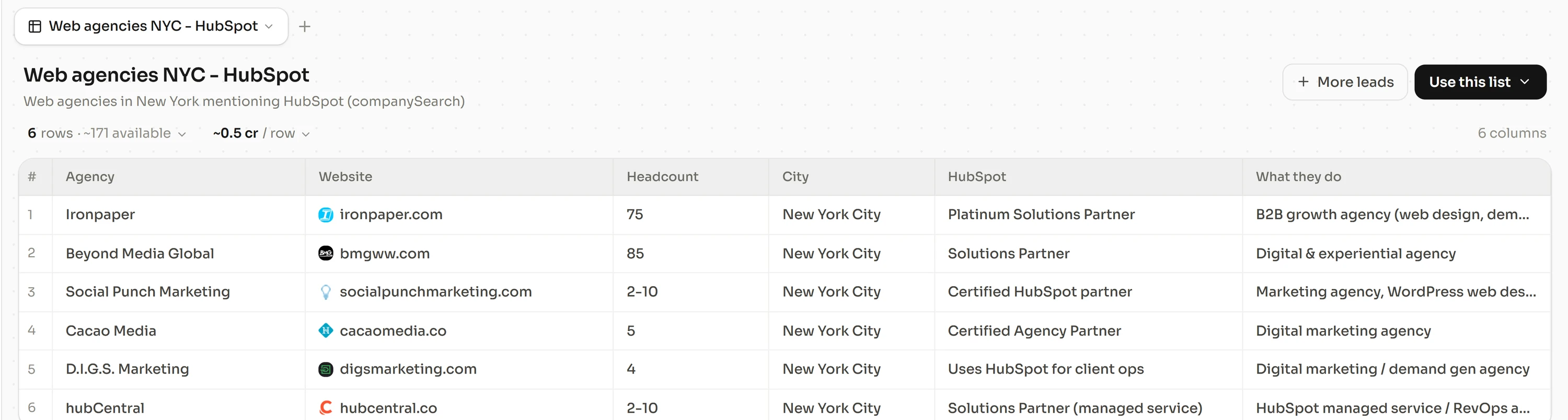
For a sales leader, two facts change the arithmetic above. Team members are unlimited on every plan, so adding a rep who prospects occasionally adds nothing to the bill and the idle-seat premium does not exist. A verified email costs 3 credits and a verified phone number 15, and nothing is billed when verification fails. Starter is €49 a month for 1,500 credits, enough for 500 verified emails, Pro is €179 for 6,000 and Max is €499 for 18,000, all without commitment. Free 7-day trial, no credit card, at freelvy.com.
How we verified this
We read the official pricing pages of Apollo, Clay and Cognism, Apollo's credits page, ZoomInfo's pricing guide and Vendr's ZoomInfo contract data on September 23, 2026. Cognism and ZoomInfo publish no prices, so their amounts come from Landbase's estimates, Vendr's data and Salesmotion's relay of Vendr's Cognism figures, each named in the text. The shelfware, verification, catch-all, decay and hybrid-pricing figures come from the 2026 analyses linked in the text, read on the same day.
Every per-contact figure, the working-seat premium, the ten-user totals and the quote-based divisions are our own arithmetic on those numbers. The 20 percent unusable share is our stated assumption, not a sourced figure. Two figures seen in research were left out because no method could be traced to them, an annual tool spend of $1,200 per rep with 67 percent of features unused, and a $15 million yearly cost of poor data.
FAQ
How much should a ten-person sales team budget for prospecting data?
As of September 2026, ten Apollo seats cost $5,880 to $14,280 a year on annual billing. Quote-based vendors publish no prices, and the median ZoomInfo contract is $33,500 a year according to Vendr. Freelvy starts at €49 a month for the whole team. Add verification and sending if the data tool does not include them.
Is per-seat or usage-based pricing cheaper?
Utilization decides it. Per-seat is cheaper when every licence holder prospects every week and spends most of the credit allowance. Usage-based is cheaper when volume is uneven or when some reps prospect only occasionally, because you stop paying for seats that sit idle. Compute cost per usable contact at your real usage before choosing.
What is cost per usable contact and how do I calculate it?
It is total annual spend divided by the contacts that survive verification, not the number revealed. Take the spend, count the records actually revealed, remove the share that proves unusable, then divide. On ten Apollo Professional seats, it ranges from about $0.025 to about $0.25 depending only on how much of the allowance the team uses.
Why do some vendors not publish prices?
Quote-based vendors price each contract to the account's size and expected usage, so there is no list price to publish. For a buyer, that means cost per usable contact cannot be computed before signing, which is why marketplace data matters. Vendr's median of $33,500 a year across 1,573 ZoomInfo purchases is a useful planning number before the first quote.
How much does a phone number cost in credits?
On Apollo a phone number costs 8 credits, against 1 credit for an email, according to its credits page read on September 23, 2026. Ten Professional seats hold 480,000 credits a year, enough for 60,000 numbers. On Freelvy a verified phone number costs 15 credits and a verified email 3, and nothing is billed when verification fails.
How do I stop paying for seats nobody uses?
Count active users against licensed users every month, not at renewal. If three seats in ten sit idle on a $9,480 Apollo contract, each working seat costs about $1,354 instead of $948. If the ratio does not improve within two months, a model without seat licences, such as Freelvy or Clay, fits the team better.
Should I prepay a year of data?
Prepay only against a usage forecast you can defend. Annual billing lowers the monthly price, $79 per seat on Apollo Professional against $99 billed monthly, but credits granted upfront only pay off if the team uses them within the year. Prepay when volume is high and predictable, and stay monthly when it is not.
Sources and methodology
Pages read on September 23, 2026. Figures are attributed in the text to the pages that published them.
- https://www.apollo.io/pricing
- https://www.apollo.io/pricing/about-credits
- https://www.clay.com/pricing
- https://www.cognism.com/pricing
- https://pipeline.zoominfo.com/sales/how-much-does-zoominfo-cost
- https://www.vendr.com/marketplace/zoominfo
- https://www.landbase.com/blog/cognism-pricing
- https://salesmotion.io/blog/cognism-pricing
- https://salesmotion.io/blog/per-seat-vs-account-based-pricing
- https://www.nxcode.io/resources/news/saas-pricing-strategy-guide-2026
- https://instantly.ai/blog/2026-email-verification-benchmark-accuracy-scores-for-8-top-tools/
- https://lagrowthmachine.com/email-verification-software-2026/
- https://www.cleanlist.ai/blog/2026-01-22-b2b-data-decay-statistics
- https://www.lusha.com/blog/b2b-data-decay-rate-measured/