Turn a description no filter can express into a list by splitting it into attributes a database holds and evidence only a live source shows.
Key takeaways
- In a 2026 guide, Merit Data, a B2B data provider, calls industry, company size and job title "necessary but nowhere near sufficient" for defining an ICP.
- Apollo's API reference, read on September 23, 2026, filters companies on job titles in active postings, technologies in use and latest funding date. No field carries a clause such as "first sales hire".
- LinkedIn's help center, read on September 23, 2026, says an audience must match at least 300 member accounts before an ad set can use it.
- A May 2026 agency benchmark reports 90 to 98 percent match for company lists with name plus domain, while a March 2026 guide gives 60 to 85 percent for well-known companies.
- Cleanlist's 2026 statistics put B2B contact decay at about 2.1 percent a month. At that rate, a list built 90 days before the send has lost about 6.2 percent of its accuracy.
- Lusha counted 1,470,414 company changes worldwide between January and June 2026, about 13,600 contacts changing jobs every working day.
Why can't database filters express a campaign brief?
Most filters describe what a company is, while a real brief usually hinges on something the company did recently. Databases now filter on a few behaviours, such as hiring and funding, but the clause a campaign actually depends on, like a first sales hire or a second location, rarely has a field of its own.
Marketers describe the segment they want in a sentence, then find that the filter panel has no field for it. Merit Data, a B2B data provider, put it plainly in a 2026 guide. Industry, company size and job title are "necessary but nowhere near sufficient". The same guide illustrates the point with two companies that share a firmographic profile, where one is evaluating with budget available and the other will not buy for eighteen months.
The better databases now cover some behaviour too. Apollo's organization search, for instance, filters on job titles in active postings, the date jobs were posted, technologies in use and the latest funding date. What no filter panel carries is the specific clause your brief hinges on (a first sales hire rather than any sales hire, a second location, ads running without a working storefront).
Headline coverage numbers do not settle the question either. A January 2026 roundup by Landbase credits InfobelPRO with more than 360 million companies across 220 countries and territories, and ZoomInfo with a 95 percent-plus accuracy rate for contact data. The first figure counts entities and the second is a quality claim about one vendor's records. Neither says how many companies match your brief.
How do you find companies by what they do, not what they are?
Look for where the behaviour becomes publicly visible instead of looking for a filter. Decompose the description clause by clause, label each clause as an attribute or as evidence, and note the type of source that shows it and how quickly that signal goes stale.
"Companies that recently opened a second location." "Companies that are hiring their first salesperson." "Companies advertising without a working storefront." Each of these is a real segment, and none of them is a checkbox.
The attribute rows are what a stored database is built for, and some evidence rows now exist as filters too, in the vendor's own taxonomy. The rows that stay out of reach are the specific or recent ones, because a snapshot refreshed on a cycle cannot know what happened last week. The registry appears on both sides of the table. It holds attributes such as legal form and sector, and it also records dated events such as incorporation and filings.
Work the evidence rows first. They are smaller, they give you the reason to write, and they usually shrink the list to something a campaign can actually cover. Tools that query live sources rather than filter a snapshot are covered in our roundup of AI prospecting tools.
How do you build a list when no filter has the right word?
Split the description into two layers and take their overlap. The attribute layer holds everything a filter can express, kept as loose as possible. The evidence layer holds one or two dated, checkable facts that must be true. The overlap is your list, and it is usually smaller and far more usable than a filter output.
Sometimes the brief is not behavioural at all. It is a plain-language description that no filter taxonomy has a word for, such as an operator who serves other businesses in a particular way, or a company at a specific stage of building a function.
The attribute layer is everything a filter can express, and you should make it as loose as you can bear. Every extra filter narrows the pool before the evidence layer has had a chance to qualify anyone. A common failure is stacking six filters, ending with 40 companies, and concluding that the segment does not exist.
The evidence layer is one or two dated, checkable things that must be true. Three or four conditions are too many. One good piece of evidence per row makes the row defensible to a sales leader who asks why a given company is on the list, and it also gives the campaign its opening line.
Then take the overlap. Loose attributes with tight evidence give a list that is smaller than the filter panel suggested, and far more workable. Tight attributes with no evidence give a list that looks precise and behaves like a guess. That is the brief our page for marketing teams is built around.
- A one-sentence brief
- A loose attribute layer
- One or two dated facts
- A count per condition
- The overlap of both layers
- Verification on send day
How do you count a segment before you spend on data?
Count before you spend. Record the attribute layer alone, then apply each evidence condition separately and record each figure, then apply them together. The final figure is your addressable count, and the intermediate figures show which clause to relax if the count comes out too small.
If you do not know whether the segment holds 400 companies or 9,000, you cannot size the campaign, and you will discover the answer after the invoice. Recording each condition separately tells you which one is doing the narrowing.
This is also where the contact question belongs. A count of companies is not a count of reachable people. Verified contacts are a separate yield on top of the company count, and if you skip that step you will budget against companies and execute against half of them. Our guide on what prospecting data costs a sales team works through cost per usable contact, which is the number the count should ultimately produce.
Why does an uploaded audience match so poorly?
Usually because of the list format rather than the ad platform. On LinkedIn, the reference platform here, company lists that carry name plus domain match far better than contact lists, and an audience that matches fewer than 300 member accounts cannot be used in an ad set at all.
LinkedIn's help center defines match rate as the share of uploaded entries that matched a member account or, for company lists, a LinkedIn Page. It also says that including the company website or the LinkedIn Company Page URL helps a company list match, and that a list must match at least 300 member accounts before an ad set can use it.
Published rates differ by source. A May 2026 agency benchmark puts company lists with name plus domain at 90 to 98 percent, and contact lists at 70 to 85 percent on work emails, 40 to 60 percent on personal emails and 60 to 70 percent on mixed lists. A March 2026 guide is more cautious, at 60 to 85 percent for well-known companies and 30 to 60 percent for contact lists.
Here is an illustration in numbers. A 400-person contact list that matches at 60 percent, the top of the cautious range, yields about 240 member accounts. That is under the 300 minimum, so the campaign cannot deliver.
So the practical rule is to always carry the domain, and to treat the company row as the primary unit with contacts attached to it, rather than the reverse. The fix sits upstream, in how the seed audience is sourced, and not in the platform settings.
How fast does a B2B list go stale between build and send?
Fast enough to matter over a campaign timeline. Cleanlist's 2026 statistics put B2B contact decay at about 2.1 percent a month, or 22.5 percent a year. At that rate, a list built 90 days before the send has lost about 6.2 percent of its accuracy before the first email goes out.
Lists are perishable and campaign timelines are long. Cleanlist's 2026 decay statistics give about 22.5 percent a year, roughly 2.1 percent a month, driven mainly by 15 to 20 percent of professionals changing jobs each year. The same 2.1 percent rate appears on HubSpot's Database Decay Simulation, which credits it to MarketingSherpa research. Fresher counts point the same way. ZeroBounce's Email List Decay Report for 2026, built on more than 11 billion addresses processed in 2025, finds that at least 23 percent of an email list decays within a year. Lusha detected 1,470,414 company changes worldwide between January and June 2026, about 13,600 contacts changing jobs every working day.
At 2.1 percent a month, compounded, here is what the gap between build and send costs you.
Those numbers are small enough to ignore and large enough to explain a bad bounce report. The fix is a verification pass on the morning of the send rather than on build day, which also protects the sending domain that carries your nurture and lifecycle mail. Instantly's 2026 guidance on list uploads says to keep bounce rates at or below 2 percent and treats anything above that as a sign of poor list hygiene. Our guide on verifying a B2B email list sets out the checks and what they cost per thousand records.
The evidence layer decays faster than the contacts do. A funding announcement stays a reason to write for weeks. A job posting stays a reason to write for days. If the campaign slips a month, source the evidence again rather than resending against a trigger that has closed.
How do you write a description that produces a list?
Write it as a sentence a colleague would understand, then annotate it. Name the attribute clauses and the evidence clauses. For each evidence clause, name the type of source where it becomes visible and how long the window stays open.
Here is a worked example. "Companies in your region, in professional services, between ten and fifty people, that posted a role for a first sales hire in the last thirty days." The attributes are the region, the sector and the headcount band. The evidence is the posting, visible on job boards, with a window of days rather than months. A job-title filter can find a sales posting, but the word "first" is what no filter carries, and it is what makes the company worth writing to. The opening line follows from the evidence clause, and the sales leader who asks why a company is on the list gets a dated answer.
Compare that with "mid-market companies that are ready to buy". It has the same length, but it names no evidence, no source type and no date. That brief will come back as a filter output, and it will look exactly like the last one.
Where Freelvy fits
Freelvy is an AI sales platform, used the way you use ChatGPT or Claude. You write the description in one prompt, in plain language and including the evidence clause. The agent then searches 40+ live data sources at query time (maps, official company registries, job boards, storefronts, ad libraries) instead of filtering a stored snapshot. It enriches every row with verified contacts through provider waterfalls (six providers for email, nine for phone), and a row that fails verification is never delivered and never billed. Search, enrichment and sequencing sit in one thread, so the evidence that qualified a company stays attached to the message that mentions it. Plans start at €49 a month for 1,500 credits, with unlimited team members and no commitment.
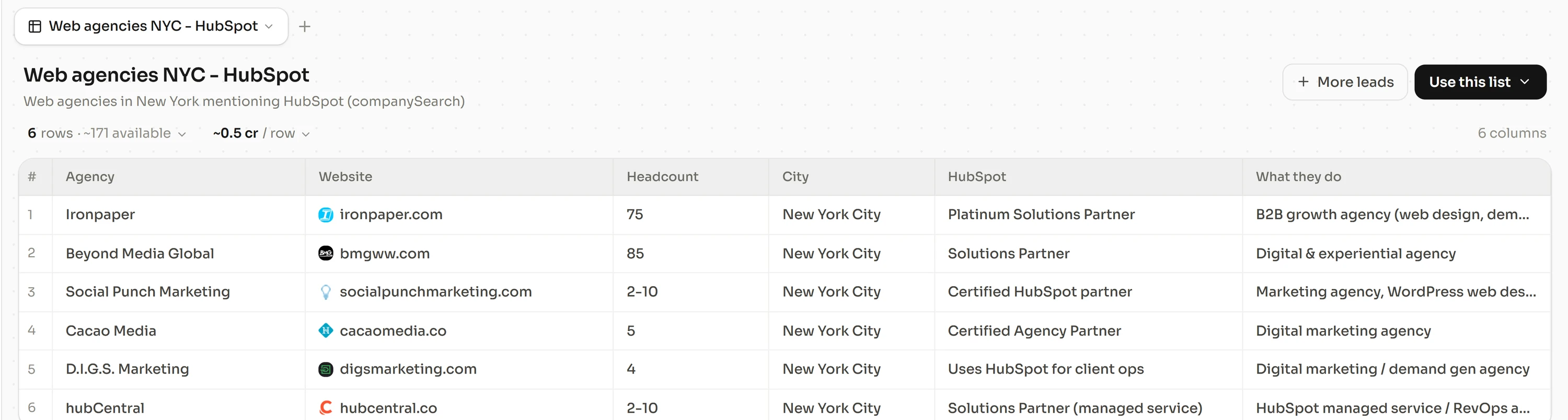
The annotated sentence from the previous section is the kind of prompt it takes as it is. The region, sector and headcount describe the company, and the first sales hire is the evidence that job boards show. Free 7-day trial, no credit card, at freelvy.com.
How we verified this
We read every page listed under Sources on September 23, 2026. Where a platform publishes its own documentation, we used it, namely LinkedIn's help center for match rates and the 300-member minimum, Apollo's API reference for its filters, and HubSpot's page for the origin of the 2.1 percent rate. The 400-contact illustration and the compounded decay table are our own arithmetic on those published figures.
FAQ
Why can't I build my ICP list with filters?
Because most filters describe what a company is rather than what it recently did. Merit Data calls industry, size and job title necessary but nowhere near sufficient in 2026. Some databases now filter on hiring, technologies and funding, but the specific clause a brief hinges on, such as a first sales hire, rarely has a field.
How do I turn a plain-language description into a list?
Split it into an attribute layer and an evidence layer. Keep the attributes as loose as you can bear, because every extra filter narrows the pool before qualification. Add one or two dated, checkable pieces of evidence that must be true, then take the overlap of the two. The evidence is also your opening line.
Which sources show what a company is doing right now?
Think in types of source rather than names. The official company registry carries registration dates, legal form, declared activity and dated filings. Job boards carry hiring intent. Maps listings carry new locations. Storefronts carry what a company sells and how. Public ad libraries carry advertising activity. Review platforms carry service quality patterns.
How many companies should a segment contain?
Enough that the campaign can cover it at the personalisation level you intend, which usually means the evidence layer rather than the attribute layer sets the size. Count the attribute layer first, then each evidence condition separately, so you know which clause is doing the narrowing before you relax anything.
Why did my uploaded audience match so poorly?
Usually because of the seed format. A May 2026 agency benchmark puts LinkedIn company lists with name plus domain at 90 to 98 percent and contact lists at 70 to 85 percent on work emails, while a March 2026 guide gives 60 to 85 and 30 to 60 percent. Always carry the domain, and remember that LinkedIn needs at least 300 matched member accounts.
How often should a campaign list be rebuilt?
Verify contacts on the morning of the send rather than on build day, and source the evidence again if the campaign slips. At a published 2.1 percent decay a month, a 90-day gap costs about 6.2 percent of accuracy, and the evidence clause ages faster than the contact does, in days for a job posting and weeks for a funding event.
How do I justify why a company is on a target list?
Give each row its own dated evidence. That is the practical argument for the evidence layer over an intent score with no source. When a sales leader asks why a given company is on the list, a registry filing date, a posting date or an ad-library appearance is an answer, and a percentage from a black-box model is not.
Sources and methodology
All pages below were read on September 23, 2026. Figures are attributed in the text to the pages that published them.
- https://www.meritdata-tech.com/resources-post/blog-how-to-build-icp-strategy-2026
- https://docs.apollo.io/reference/organization-search
- https://www.landbase.com/blog/firmographic-coverage-statistics
- https://www.linkedin.com/help/lms/answer/a420595
- https://www.linkedin.com/help/lms/answer/a423102
- https://www.growthspreeofficial.com/blogs/linkedin-matched-audiences-b2b-2026
- https://benly.ai/learn/linkedin-ads/linkedin-matched-audiences
- https://www.cleanlist.ai/blog/2026-01-22-b2b-data-decay-statistics
- https://www.hubspot.com/database-decay
- https://www.zerobounce.net/email-list-decay
- https://www.lusha.com/blog/b2b-contact-change-report/
- https://instantly.ai/blog/email-list-validation-upload-quality-checks/