
Work a fixed list of fifty accounts in four weekly hours: pick by fit, find a dated reason, map three contacts, verify, then sequence and call.
Key takeaways
- Salesforce's State of Sales 2026, a survey of 4,050 sales professionals, found that sellers spend 40% of their time actively selling.
- The Bridge Group's 2026 AE research reported that 48% of account executives were at quota, down from 51% in 2024.
- Instantly's Cold Email Benchmark Report 2026 measured an average reply rate of 3.43%, with 58% of replies coming from the first email.
- Gartner reported in May 2025 that B2B buying groups range from 5 to 16 people across as many as four functions.
- Gong's 2025 analysis of 1.8 million opportunities found win rates about 130% higher on multithreaded deals above $50,000.
An account executive with no SDR has a quota and a calendar full of deals. Prospecting is the only task with no deadline, so it loses every week. This guide is about the order of the work, not the volume, so that a finished list is waiting when you sit down between calls.
Why does self-sourcing die first in an AE's week?
Because every other task has someone waiting. A prospect expects the proposal, a manager expects the forecast, legal expects the redlines. Nobody expects the new list, so it slides to Friday afternoon and then to next week. The pipeline gap shows up a quarter later, when it is too late to fix.
Selling time is already squeezed. Salesforce's State of Sales 2026 found that sellers spend 40% of their time actively selling and the rest on other work. Self-sourcing has to fit inside that 40%, next to live deals.
The stakes are real. The Bridge Group's 2026 research on AE models reported that 48% of account executives were at quota, down from 51% in 2024.
The fix below is grouped by pain. Each one has a single move, and together they fit in four hours a week.
Pain 1: there is never a free afternoon
Book two fixed blocks of two hours, on the same days every week, and protect them like a customer call. The first block builds and refreshes the list. The second sends and calls. Splitting build from send stops research from eating the time meant for outreach.
Ten accounts a week means the fifty-account list turns over in five weeks. That is slow enough to do each account properly and fast enough to keep the pipeline moving.
Pain 2: you don't know which accounts to work
Start from your last ten won deals, not from a territory alphabet. Write down what they share: size, business model, a tool they ran, an event that preceded the deal. That shape is your filter. Fifty accounts that match it beat five hundred that only match an industry code.
Keep the list small on purpose. Fifty is a number one person can actually know: who the buyer is, what changed lately, what was said last time. A long list turns into a mail merge, and a mail merge reads like one.
Remove what you cannot sell to. Drop accounts with an open opportunity owned by a colleague, current customers and companies on the do-not-contact list before you research anything. Ten minutes of exclusion saves an awkward call from your manager.
Refresh the list every Monday. Accounts that went nowhere after a full sequence leave, and accounts with a new trigger come in.
Pain 3: you have no reason to write
Attach one dated, checkable event to each account before you write a word. A hiring wave for the team you sell to, a new location, a funding round, a leadership change or a public complaint you can fix. The event is the reason for the email, and it goes in the first line.
Buyers are harder to reach without one. An email that opens on something true about their business earns the read that a generic one does not.
Freshness matters as much as the event. A job posting from last week is a reason. One from last year is trivia. Our guide to buying signals worth prioritising ranks the common events by how long each window stays open.
If you cannot find an event in five minutes, move the account to next week. It is not ready yet.
Pain 4: you only know one person at each account
Map three people per account before the first send: the likely buyer, the person who feels the problem every day, and the person above them. A single contact who goes quiet ends the thread. Three contacts give you three ways in and a better picture of who signs.
Buying groups are large. Gartner reported in May 2025 that B2B buying groups range from 5 to 16 people across as many as four functions. Reaching three of them from the start is a modest share of that group.
It also shows in win rates. Gong's 2025 analysis of 1.8 million opportunities found that multithreaded deals above $50,000 win about 130% more often. That is a correlation in Gong's own data, but it points the same way as every buying group study.
Verify every address before it enters a sequence. Our guide to multi-threading a deal past one contact covers how to find the people above and beside your first contact.
Pain 5: the list dies between sessions
Put every account into a short sequence the day it is ready, and pair it with calls. Four emails over about two weeks, each one standing on its own, plus a call after the first reply or open signal. The sequence keeps the account moving while you are in meetings.
The first email does most of the work. Instantly's Cold Email Benchmark Report 2026 measured an average reply rate of 3.43%, with 58% of replies coming from step 1. Follow-ups still bring the other 42%, so stop at four or five steps rather than at one.
Calls convert the warm replies. Belkins' 2026 cold calling benchmarks, built on more than 175,000 dials, found that 9.9% of dials reach a live person and 4.6% of conversations book a meeting. Calling ten accounts that already read your email beats dialling a hundred cold.
Stop the sequence the moment someone replies, and log the outcome on the account, not in your inbox.
- Pick ten accounts by shape
- Find one dated reason
- Map and verify three contacts
- Send the first email
- Call the people who opened
A template you can copy
Here is the brief and the sequence we would give an AE starting on Monday. Replace the bracketed parts. The brief builds the ten accounts, and the sequence works them.
Brief:
Find 10 companies that look like my best customers: [size range],
[business model], using [tool or platform], in [your region].
Each must show one event from the last 60 days: hiring for [team],
a new location, funding, or a new [role] leader.
For each, give 3 people: the [buyer title], the [daily user title]
and their manager, with verified work emails.
Exclude my CRM's open opportunities, customers and do-not-contact list.

Sequence (4 emails over 12 days, stop on reply):
Day 1  - First line on the event. One sentence on the problem it creates.
         One question.
Day 4  - A different angle: what similar companies changed after the
         same event. No attachment.
Day 8  - To the second contact, referencing the event, not the first email.
Day 12 - Short close: "Is this on your list this quarter, or should I
         come back after [month]?"
Call   - Same day as any open or reply, to the person who engaged.
Where Freelvy fits
Freelvy is our product, an AI sales platform used the way you use ChatGPT or Claude. You paste a brief like the one above, and Freelvy searches 40+ live sources at query time, including maps, official company registries, job boards, storefronts and ad libraries, instead of filtering a stored database.
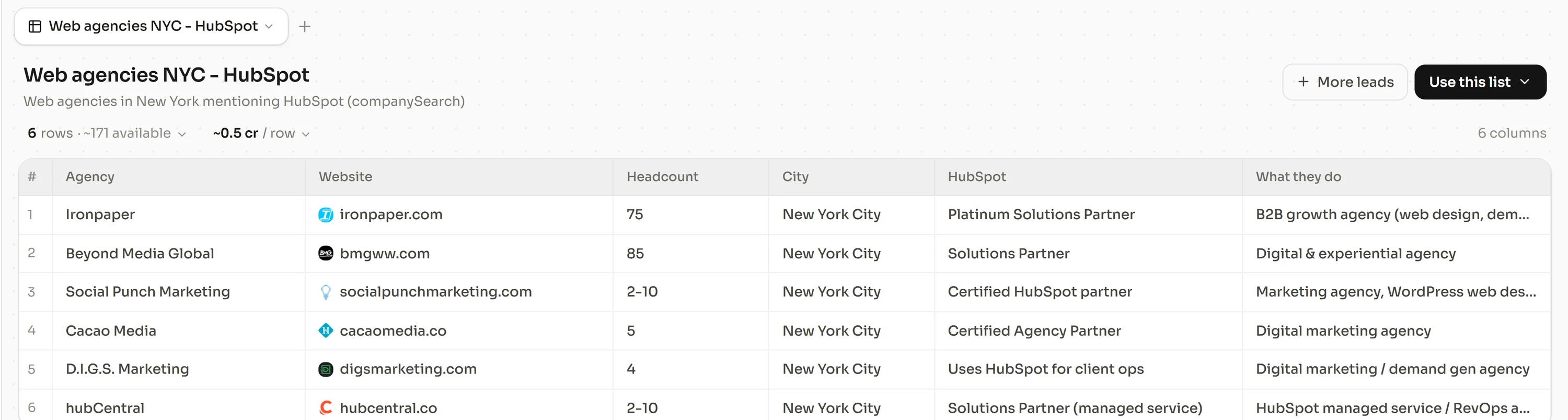
Every row is enriched through cascades of 18 email providers and 12 phone providers, which find and verify more than 92% of emails and find more than 90% of phone numbers. Freelvy then writes and sequences the outreach in the same thread. A scheduled search can rerun the brief every Monday, so the build block starts with a refreshed list.
Pricing is per seat, billed monthly, with no lock-in. Starter costs €99 per seat a month with 2,200 credits per seat, and Pro €199 with 4,500. A verified email costs 3 credits and a phone number found costs 15, and an email lookup that finds nothing is never billed. Sending accounts for email and LinkedIn are included per seat, and the sequencer is unlimited.
Free 7-day trial, no credit card, at freelvy.com.
Freelvy isn't for teams that would rather pay one tool for the data, another for enrichment and a third for sending.
How we verified this
On October 19, 2026, we read Salesforce's State of Sales report 2026, the Bridge Group's 2026 AE Models, Motions and Metrics research summary, Instantly's Cold Email Benchmark Report 2026, Gong's best sales insights of 2025, Gartner's press release of May 7, 2025, and Belkins' 2026 cold calling benchmarks. The weekly schedule, the brief and the sequence are our own work.
FAQ
How much of an AE's pipeline should be self-sourced?
There is no reliable industry figure, so set it from your own numbers. Divide your quota gap by your average deal size and win rate to get the opportunities you need, then subtract what marketing and partners usually bring. The rest is your self-sourcing target.
How many accounts should an AE prospect at once?
Fifty is a workable number for one person working four hours a week. It is small enough to know each account properly and large enough to keep ten fresh accounts moving every week. Refresh it on Mondays, dropping accounts that finished a sequence without a reply.
How much time should an AE spend prospecting each week?
Four protected hours in two fixed blocks is enough for a fifty-account list, plus ten minutes a day for replies. Salesforce's State of Sales 2026 found sellers spend 40% of their time actively selling, so prospecting has to be scheduled, not squeezed in.
Should an AE send cold emails or make cold calls?
Both, in that order. Send the first email to all three contacts, then call the people who opened or replied. Belkins' 2026 benchmarks found that 9.9% of dials reach a live person, so calls work best on accounts that have already seen your name.
How many follow-ups should a self-sourced sequence have?
Four emails over about two weeks is a sound default. Instantly's Cold Email Benchmark Report 2026 found that 58% of replies come from the first email and 42% from follow-ups. Stop the sequence as soon as anyone at the account replies.
What is the best trigger for an AE to prospect on?
The best trigger is the one closest to your last won deals. If several customers bought after hiring a new leader or opening a site, that event is your signal. Use events from the last 60 days that anyone can check, and quote them in the first line.
Sources and methodology
All pages below were read on October 19, 2026. Salesforce, Instantly and Gong sell sales software, and Belkins is an outbound agency; their figures describe their own surveys or customer data.
- salesforce.com, State of Sales report 2026
- bridgegroupinc.com, 2026 AE Models, Motions and Metrics research report
- instantly.ai, Cold Email Benchmark Report 2026
- gong.io, The best sales insights of 2025
- gartner.com, Gartner sales survey finds 74% of B2B buyer teams demonstrate unhealthy conflict, May 7, 2025
- belkins.io, B2B cold calling statistics 2026