
You cannot see readiness, only recent change. Prioritise fresh, checkable events such as a hiring wave or new ads, and write within their window.
Key takeaways
- 6sense's 2025 Buyer Experience Report, consulted on September 27, 2026, found that 94% of buying groups had ranked preferred vendors before first contact with any seller.
- Instantly's 2026 Cold Email Benchmark Report puts the platform-wide average reply rate at 3.43%, with the top 10% of senders at 10.7% or more.
- At a dozen emails a week, that gap is about 21 replies a year against about 67, by our arithmetic on those two figures.
- Crunchbase counted $205 billion invested in more than 5,000 startups worldwide in Q2 2026, which makes a funding round the most crowded signal to open on.
- Google's 2025 Maps figures, published in April 2026, show more than 292 million policy-violating reviews blocked or removed, so one review proves little and a pattern proves more.
- In our scoring, a hiring wave in one function scores 9 out of 9, and a third-party intent score scores 3.
How do you know which companies are ready to buy right now?
You do not see readiness directly. You see a company that changed something recently and publicly. A signal is worth your time when it is recent, when you can check it yourself, and when it gives you a natural first sentence.
6sense's 2025 Buyer Experience Report surveyed nearly 4,000 B2B buyers. Buyers made first contact at 61% of the journey, down from 69% the year before. 6sense sells intent data, so read it as a vendor's survey.
The same report found that 94% of buying groups had ranked preferred vendors before first contact. The pre-contact favourite won 77% of the time.
For a founder, the lesson is timing. An email that arrives after the shortlist is drawn rarely changes it. A readable signal is the closest public proxy for "they are starting to look".
Why is hit rate per email the only lever for a founder?
Because volume is fixed by your calendar. A founder who sells between delivery and payroll can research and write about a dozen emails a week. He cannot double that without dropping quality. The only number he controls is how many of those twelve reach a company at the right moment.
The platform benchmarks show how wide the gap is. Instantly's 2026 Cold Email Benchmark Report, built on its own platform data, gives an average reply rate of 3.43%. The top 10% of senders clear 10.7%. Instantly sells a sending tool, so these are one vendor's platform figures.
Here is what that means over a year, by our own arithmetic. Twelve emails a week for 52 weeks is 624 first emails. At 3.43%, that yields about 21 replies. At 10.7%, it yields about 67.
The difference is roughly 46 conversations a year from the same hours of writing. Much of that gap comes from writing to the right company in the right week. That is the case for a short list built on signals, which our founder page on selling without an SDR team is built around.
What makes a buying signal worth acting on?
Three tests, in this order. Freshness asks whether the event is recent enough that the company is still acting on it. Verifiability asks whether you can open the source and see the event with a date. Openability asks whether you can mention it in the first line without sounding like surveillance or like every other vendor.
Freshness matters because signals decay. A posting that has been up for months may be a role nobody fills.
Verifiability matters because you will cite the event. If you write "saw you opened a second site" and the site opened two years ago, the email is over. A dated public record protects you.
Openability is the founder's own test. Some true signals are awkward to raise. A run of bad reviews is real, but opening on it can read as an accusation. A funding round is easy to mention, but everyone mentions it.
Fit comes before all three. A signal at a company outside your customer profile is noise, however fresh. Our guide on building a list from a description covers the fit layer.
Which buying signals score highest?
A hiring wave in one function scores highest in our table, because it is fresh, dated on job boards and easy to mention. Ad activity and a funding round follow. A third-party intent score scores lowest, because you cannot check it or quote it. Each criterion is scored 0 to 3, so the maximum is 9.
The scores are our judgment, not a measurement, and assume a founder writing a short personal email. The intent score gets a zero on openability because you cannot write "your account surged on a topic" to a stranger. You can write "saw you are hiring three account executives".
How long does each signal's window stay open?
Most readable signals stay useful for days to weeks, not months. A hiring wave lasts as long as the postings are live. Ads last as long as they run. A funding round cools within a few weeks. These ranges are our working estimates, not measured values.
Funding is the most visible and the most crowded. Crunchbase counted $205 billion invested in more than 5,000 startups worldwide in Q2 2026. Every round reaches every vendor on the same morning. The better move is often to wait for the second-order signal, the hiring that follows the round.
People changes happen constantly. Lusha, a contact-data vendor, detected 1,470,414 company changes worldwide between January and June 2026, about 13,600 a working day. A new executive or partner is a real opening, but only when the new person owns the budget you sell into.
Reviews need a pattern, not a single post. Google's 2025 Maps figures, published on its blog in April 2026, show more than 292 million policy-violating reviews blocked or removed and over 13 million fake Business Profiles taken down. One review can be noise. Five recent reviews naming the same problem are a signal.
Ads are the easiest to date. Meta's Ad Library lets anyone search the active ads a page is running, with each ad's start date.
Are intent data scores worth it for outbound?
For a founder sending a dozen emails, rarely. An intent score says an account showed interest in a topic, according to a model you cannot inspect. It can help rank a large account list. It cannot give you a dated fact to write about, and a founder's email lives or dies on that fact.
Public events carry their own proof. A job posting has a date and a URL. When a prospect asks "how did you know?", you can answer.
Intent scores answer a different question. They suit a team that must sort thousands of accounts before anyone writes. Autobound, a vendor of signal-based email tools, reports reply rates of 15% to 25% for emails that reference a specific buying signal, a vendor claim worth testing on your own sends. Our roundup of AI prospecting tools covers tools that read live sources.
Which signal should you prioritise for your situation?
Pick the one signal that proves the need your offer solves, and watch only that one for a month. A founder who sells to growing teams should watch hiring. One who sells to multi-site operators should watch new locations. One who sells marketing services should watch ad activity.
You sell something a growing team needs. Watch hiring waves in the function that will use it. Three open roles in sales, support or engineering are a budget with a headcount attached.
You sell to businesses with physical sites. Watch new locations on maps and in registry filings. A new site means suppliers that nobody has chosen yet.
You sell marketing or conversion services. Watch ad libraries. A company that has just started spending on ads has a budget and a result it wants to improve.
You sell to recently funded startups. Watch the round, but write when the hiring starts. The round tells you who has money. The postings tell you where it is going.
You sell advice to leadership. Watch new executives and partners, and write within their first months.
You sell reputation or service fixes. A review pattern is your signal, but open on the fix rather than the complaint.
How do you track buying signals every week?
Set one scheduled watch per signal and read it on the same morning every week. The watch returns companies that match your profile and showed the signal since the last run. You check each event at its source, verify the contact, and write from the event while it is still fresh.
- Pick one signal
- Schedule a weekly search
- Check each event at source
- Verify the contact
- Write from the event
- Log replies by signal
Keep the watch narrow. One signal and one customer profile produce a list short enough to read by hand.
Check each event before you write. Open the posting, the ad or the filing and note its date. If it is older than the window in the table, drop the row.
Verify the address on the morning you send, not when the watch ran. Our guide on verifying a B2B email list sets out the checks.
Log replies by signal. After six to eight weeks you will know which signal earns replies for your offer, and you can drop the rest.
Where Freelvy fits
Freelvy is our product. It is an AI sales platform, used the way you use ChatGPT or Claude. You describe the customer and the signal in one prompt, such as "companies in your city hiring their first sales rep". Freelvy searches 40+ live sources at query time (maps, official company registries, job boards, storefronts, ad libraries) instead of filtering a stored database.
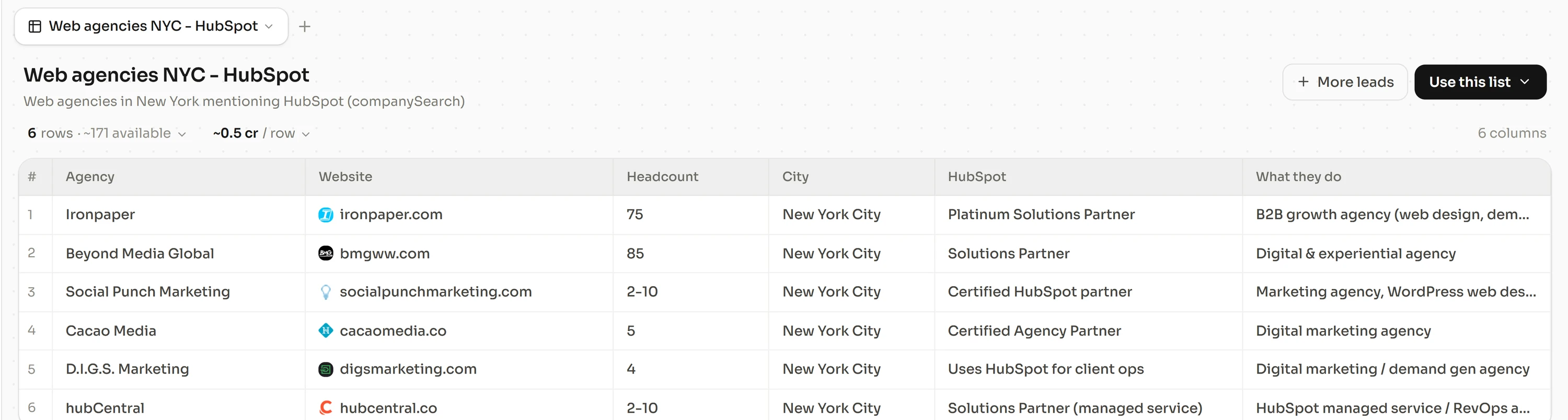
It enriches each row with verified contacts through provider waterfalls, 23 for email and 13 for phone. The waterfalls find and verify more than 92% of emails and find more than 90% of phone numbers. A row that fails verification is never delivered and never billed. Buying signals cover hiring, funding, reviews and ads, and a brief can run on a schedule, which is the weekly watch above.
Search, enrichment and sequencing stay in one thread, so the event that qualified a company stays attached to the email that mentions it. The sequencer sends from your own Google or Microsoft mailbox and is not billed per email. Starter is €49 a month for 1,500 credits, with unlimited team members and no lock-in.
Free 7-day trial, no credit card, at freelvy.com.
How we verified this
We read the pages listed under Sources on September 27, 2026. The scores in the signal table, the window estimates and the annual reply arithmetic are our own work on the published figures.
FAQ
What are B2B buying signals?
They are public, dated events that suggest a company's needs just changed. Common ones are a hiring wave, a funding round, a new location, a new executive or partner, a run of reviews on the same issue, and new ad activity. They show that something moved and when. They do not prove a company intends to buy.
How do I know when a company is ready to buy?
You infer it from recent change that matches the problem you solve. A company hiring three salespeople this month has a need your sales offer can address now. Check the event at its source, confirm its date falls within the signal's window, and write while the change is still on the buyer's desk.
Which buying signal is the strongest for cold email?
In our scoring, a hiring wave in one function scores highest, at 9 out of 9. It is fresh, dated on job boards and easy to mention in a first line. The strongest signal for you is still the one that proves the need your offer solves, so test it against your own replies.
How long does a buying signal stay valid?
Usually days to weeks. By our working estimates, a hiring wave lasts while postings are live, ads while they run, and a funding round two to six weeks. A new executive's window spans the first months in the role. Past the window, check the source again before you write.
How do I track buying signals for outbound campaigns?
Run one scheduled search per signal and read it on the same morning each week. Keep the watch to one signal and one customer profile. Check each event at its source, verify the email on the day you send, and log replies by signal so you can drop the ones that do not work.
Are intent data scores the same as buying signals?
No. A buying signal is an event you can open and date, such as a job posting or an ad. An intent score is a vendor's model output that says an account showed interest in a topic. Scores can rank large account lists, but a founder cannot quote one in an email.
How many signals should a founder track at once?
One, for at least a month. A dozen emails a week is too few to compare several signals fairly. Pick the signal closest to the need you solve, log the replies, then add a second signal only when the first has a clear result.
Sources and methodology
All pages below were consulted on September 27, 2026. Figures are attributed in the text to the pages that published them. Scores, window estimates and annual reply figures are our own.
- 6sense.com, science of b2b buyer experience report 2025
- instantly.ai, cold email benchmark report 2026
- news.crunchbase.com, venture global startup exits ipo ma soar ai q2 h1 2026
- lusha.com, blog b2b contact change report
- blog.google, maps new ways were protecting businesses on maps
- facebook.com, help 259468828226154
- autobound.ai, blog cold email guide 2026