
An SDR to AE handoff should carry why the account fits, the dated trigger, the prospect's words, who else is involved, and the agreed next step.
Key takeaways
- The Bridge Group's 2025 SDR Metrics report, as relayed by Cience in 2026, gives a global median quota of 10 meetings held per month.
- The same summary reports that only about 60% of SDRs reach quota.
- Practitioner analyses published in 2026 by MarketBetter and SMARTe put outbound meeting show rates at roughly 70% to 80%.
- Gartner reported in May 2025 that B2B buying groups range from 5 to 16 people across as many as four functions.
- Salesforce's State of Sales 2026, a survey of 4,050 sales professionals, found that sellers spend 40% of their time actively selling.
- Gartner reported in March 2026 that 67% of B2B buyers prefer a buying experience without a sales rep.
An SDR or BDR is paid on meetings the AE accepts. A meeting that arrives as a name, a time and "interested" gets questioned, rebooked or rejected. This guide defines the record that should travel with every booked meeting, and what to do when the reason for the meeting is stale by the time it happens.
What should an SDR to AE handoff include?
It should include seven fields, filled before the invite goes out. They cover why the account fits, the dated trigger, the prospect's own words, their role and who else is involved, why they agreed to meet, what was sent before, and what is still unknown. With those, the AE can open on the reason the prospect said yes.
Fit and trigger come first for a reason. If either is missing, the AE cannot judge the meeting, and that is when meetings get rejected.
Why do AEs reject booked meetings?
Mostly because they cannot see why the meeting should exist. A meeting with no fit criteria, no dated reason and no quote from the prospect looks like a calendar slot, not an opportunity. The AE then has to redo the research, or returns the meeting to protect their own time.
Time is the scarce resource on both sides. Salesforce's State of Sales 2026, a survey of 4,050 sales professionals, found that sellers spend 40% of their time actively selling. An AE who must rebuild the context for every meeting loses part of that 40%.
Quota pressure makes it worse. The Bridge Group's 2025 SDR Metrics report, as relayed by Cience, gives a global median quota of 10 meetings held per month, and only about 60% of SDRs reach quota. With that pressure, borderline meetings get booked. A clear record lets the AE accept the good ones fast and return the weak ones early.
Which fields matter most to the AE?
The trigger and the prospect's own words. They tell the AE how to open the call. Account fit lets the AE accept the meeting, but the trigger and the quote let them start where the conversation actually stopped, instead of asking the prospect to describe their business again.
The trigger must carry a date. "They are hiring" is weak. "They posted two sales manager roles 12 days ago" can be checked, and it tells the AE how fresh the reason is. Our guide on which buying signals are worth prioritising explains how long each kind of signal stays useful.
The quote must be verbatim. A paraphrase like "interested in our solution" says nothing. One sentence in the prospect's words gives the AE the language to use on the call.
Who else should the handoff name?
Every person the prospect mentioned, and the functions likely to be involved. Gartner reported in May 2025 that B2B buying groups range from 5 to 16 people across as many as four functions. The person who took the meeting is rarely the only one who decides.
Write the names and roles you heard. "The CFO signs anything over a set amount" or "my colleague in operations runs the current tool" are worth more than a guess. If nobody else was mentioned, say so, and add the functions you expect from the account's size.
This is how the AE avoids a single-threaded deal from the first call. Our guide on multi-threading a deal past one contact covers how to reach those people directly.
Buyers also expect less selling and more substance. Gartner reported in March 2026 that 67% of B2B buyers prefer a buying experience without a sales rep. A first call that repeats the SDR's questions confirms that preference. Those names are also what saves the deal if the champion changes jobs mid-deal.
What if the signal is stale by the meeting date?
Check the trigger again the day before the meeting. If it still holds, the AE opens on it. If it changed, the SDR adds the new fact to the record. If it disappeared, the record says so, and the AE opens on the prospect's stated goal instead.
Meetings are often booked one to three weeks out. In that time a job posting closes, a funding round becomes old news, or the contact changes roles. Opening on a stale fact makes the AE look unprepared.
No-shows are part of the same problem. Practitioner analyses published in 2026 by MarketBetter and SMARTe put outbound show rates at roughly 70% to 80%. A short confirmation email the day before, which restates the prospect's own reason for meeting, is the simplest way to protect the slot.
Fifteen minutes before the call, the AE should still do a quick check of the account. Our guide on researching an account before a sales call gives a one-pass method.
- SDR fills the record
- AE accepts or returns it
- SDR rechecks the trigger
- Confirmation restates their reason
- AE opens on their words
When should the AE return a meeting?
When fit or trigger is missing, or when the prospect gave no reason of their own to meet. Agree these rules with the AEs in advance and write them down. Returning a meeting is then a clear, fast decision, not a debate after the call.
A returned meeting should come back with a reason. "Company too small for our target" or "no dated trigger" tells the SDR what to fix in the next booking. Over a month, those reasons show where the list or the qualification bar is drifting.
Some meetings are worth keeping even if a field is weak. A prospect who wrote "we are evaluating vendors this quarter" can outweigh a thin trigger. The record makes that judgment visible.
A handover record you can copy
Paste this into the CRM note or the meeting invite. Fill every line. Write "unknown" rather than leaving a line blank, so the AE knows it was checked.
HANDOVER RECORD
Meeting:        [date, time, time zone], booked on [date]
Account:        [company name], [website]
Fit:            [industry], [size], [customer type], [criteria matched]
Trigger:        [event], dated [date], source type [job board / registry / news / site]
Trigger check:  rechecked on [date before meeting]: [still true / changed: ... / gone]
Contact:        [name], [title], [verified email], [phone if found]
Their words:    "[one or two lines quoted from the reply or call]"
Why they agreed:[their stated reason to meet]
Others involved:[names and roles mentioned] / expected: [functions]
What was sent:  [sequence name], step [n]: [subject line]
Open questions: [budget owner?] [current tool?] [timing?]
SDR:            [name]           AE decision: [accepted / returned: reason]
Keep the record short. If a field needs more than two lines, the SDR is writing the call notes for the AE, which is not the job.
Where Freelvy fits
Freelvy is our product, an AI sales platform used the way you use ChatGPT or Claude. An SDR describes the accounts to work in one prompt, and Freelvy searches 60+ live data sources at query time, including maps, official company registries, job boards, storefronts and ad libraries, instead of filtering a stored database. Freelvy also reads buying signals such as hiring, funding, reviews and ads, which is where the trigger field of the record comes from.
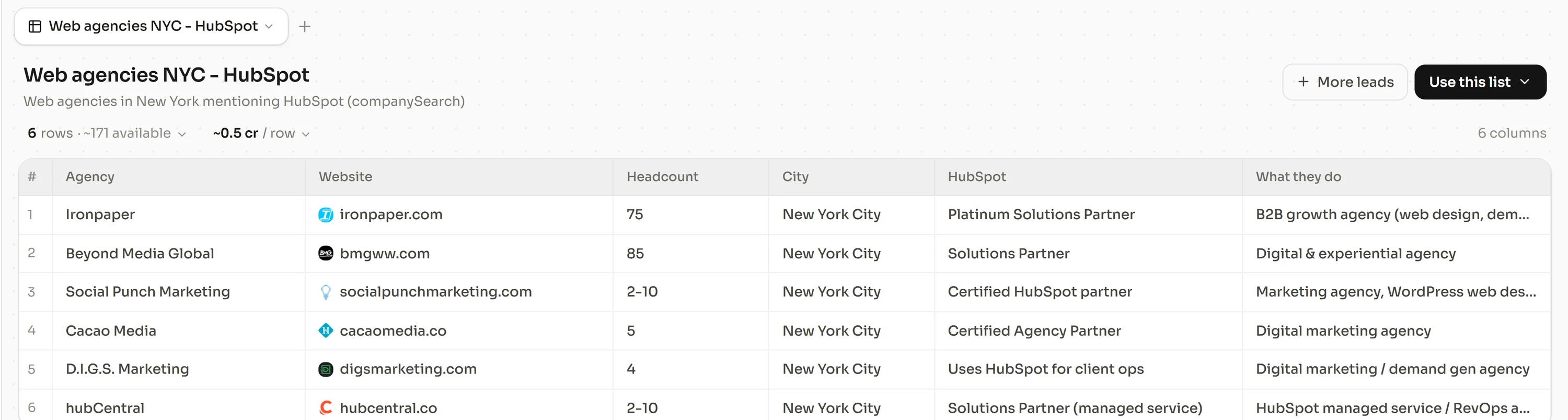
Every row is enriched through cascades of 24 email providers and 15 phone providers, which find and verify more than 92% of emails and find more than 90% of phone numbers. Freelvy then writes and sequences the outreach in the same thread, so the list, the contacts and the messages stay together.
Pricing is per seat, billed monthly, with no lock-in. Starter costs €99 per seat a month with 2,200 credits per seat, and Pro €199 with 4,500. A verified email costs 3 credits and a phone number found costs 15, and an email that is not found costs nothing. Sending accounts for email and LinkedIn are included per seat, and the sequencer is unlimited.
Free 7-day trial, no credit card, at freelvy.com.
Freelvy isn't for teams that would rather pay one tool for the data, another for enrichment and a third for sending.
FAQ
What is an SDR to AE handoff?
It is the moment a meeting booked by an SDR passes to the AE who will run it. A good handoff includes a written record of why the account fits, the dated trigger, the prospect's words and the agreed next step, so the AE can accept it and prepare.
What information should an SDR pass to an AE?
Account fit, the dated trigger, one or two lines in the prospect's words, their role and others involved, why they agreed to meet, what was sent before, and open questions. Write "unknown" where something could not be confirmed, rather than leaving it blank.
Should the SDR join the first call?
It helps on the first few calls for a new AE or a new segment, for a short introduction. After that, a complete record usually replaces it. The prospect should hear their own reason for meeting restated, whoever says it.
How do you reduce no-shows on booked meetings?
Send a short confirmation the day before that restates the prospect's own reason to meet, and recheck the trigger in case it changed. Practitioner analyses published in 2026 put outbound show rates at roughly 70% to 80%, so some loss is normal.
When should an AE reject a booked meeting?
When the account does not fit the agreed criteria, when there is no dated trigger, or when the prospect gave no reason of their own to meet. Agree these rules in advance and return each meeting with a written reason, so the SDR can adjust.
How many meetings should an SDR book per month?
The Bridge Group's 2025 SDR Metrics report, as relayed by Cience, gives a global median quota of 10 meetings held per month. Accepted meetings matter more than booked ones, which is why the handover record counts as much as the count.
Sources and methodology
All pages below were read on November 1, 2026. MarketBetter and SMARTe sell sales software, and Salesforce sells a CRM; their figures describe their own surveys and customers. The record fields, the acceptance rules and the template are our own work.
- cience.com, summary of the Bridge Group 2025 SDR Metrics report, 2026
- marketbetter.ai, SDR KPIs and benchmarks 2026
- smarte.pro, SDR metrics benchmarks 2026
- salesforce.com, State of Sales report announcement 2026
- gartner.com, Gartner sales survey finds 74% of B2B buyer teams demonstrate unhealthy conflict, May 7, 2025
- gartner.com, Gartner sales survey finds 67% of B2B buyers prefer a rep-free experience, March 9, 2026